Description
SaiyanMed Research Material
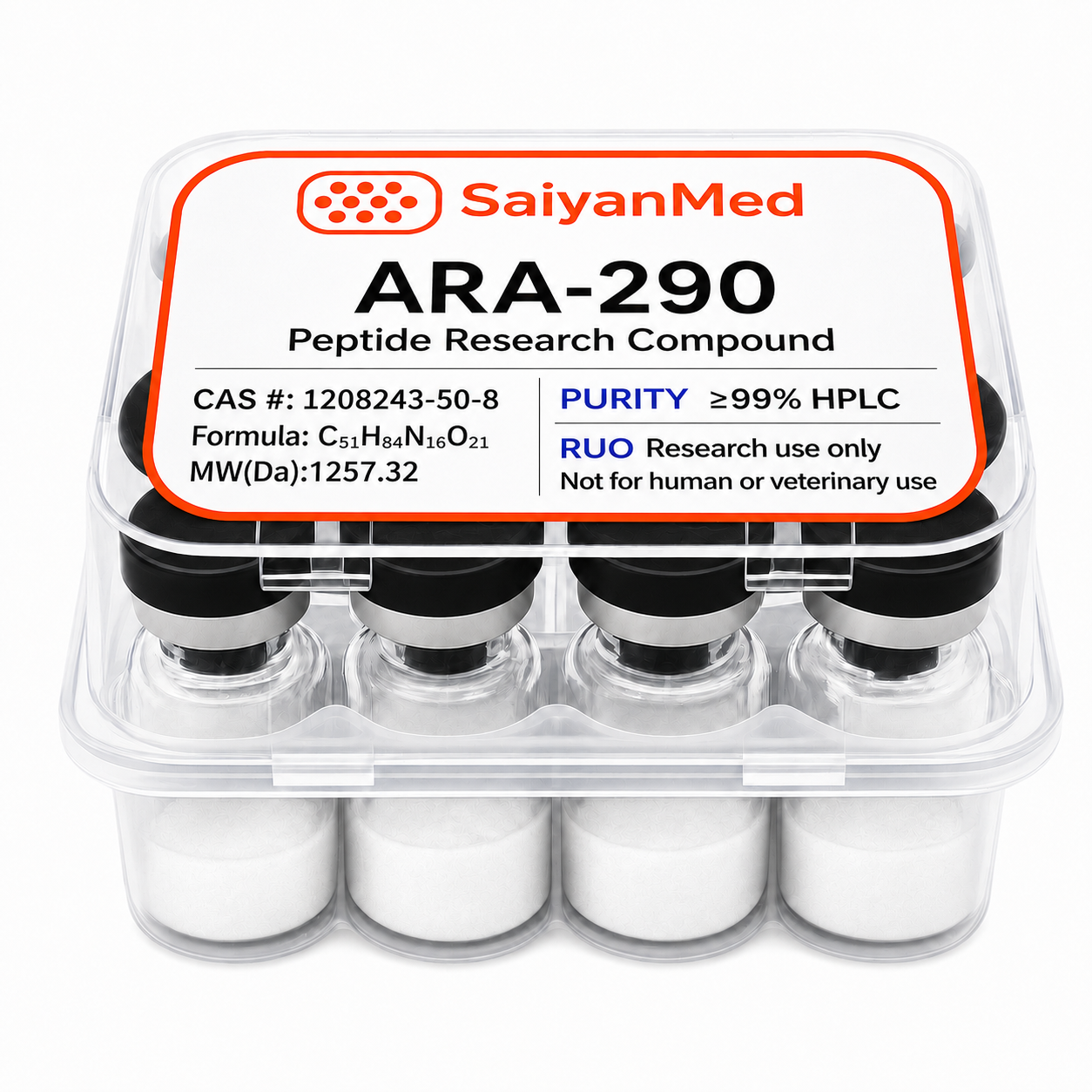
ARA290
Innate repair receptor biology · Inflammation-associated nerve injury
ARA290 is a short erythropoietin-derived peptide designed to investigate tissue-response signaling separately from red-blood-cell production. Its research profile includes the proposed innate repair receptor complex, inflammation-associated nerve injury and small-fiber structure/function endpoints measured with corneal imaging, skin biopsy and sensory testing.
Inflammation-associated nerve injury
Small-fiber imaging and sensory endpoints
Laboratory material
Research use only
RESEARCH CONTEXT
Innate repair receptor biology
A small disease-specific investigational study does not establish broad nerve regeneration, pain treatment or product safety. A 2016 erratum corrected an arithmetic error in the corneal nerve-fiber-area algorithm, so the original absolute area values are superseded by the corrected measurements.
Batch-specific documentation
RUO
Research Context
Innate repair receptor biology
The original paper describes a proposed signaling receptor complex involving erythropoietin-receptor and beta-common receptor subunits, distinct from erythropoietic signaling.
Inflammation-associated nerve injury
Small-fiber imaging and sensory endpoints
What is ARA290?
ARA290 (ARA 290; cibinetide) is an engineered 11-amino-acid erythropoietin-derived peptide investigated as a nonerythropoietic innate repair receptor agonist. ARA290 is a short erythropoietin-derived peptide designed to investigate tissue-response signaling separately from red-blood-cell production. Its research profile includes the proposed innate repair receptor complex, inflammation-associated nerve injury and small-fiber structure/function endpoints measured with corneal imaging, skin biopsy and sensory testing.
Preclinical nerve-injury and neuritis models form part of the research background discussed in the paper’s introduction; they are distinct from clinical and product-specific evidence. A small single-site, blinded placebo-controlled sarcoidosis study enrolled 38 participants and evaluated corneal nerve-fiber measurements, skin-biopsy nerve density, quantitative sensory testing and symptom questionnaires. These are investigational clinical endpoints, not product efficacy assurances.
A small disease-specific investigational study does not establish broad nerve regeneration, pain treatment or product safety. A 2016 erratum corrected an arithmetic error in the corneal nerve-fiber-area algorithm, so the original absolute area values are superseded by the corrected measurements.
🧪 Research Applications
①
Innate repair receptor biology
The original paper describes a proposed signaling receptor complex involving erythropoietin-receptor and beta-common receptor subunits, distinct from erythropoietic signaling.
②
Inflammation-associated nerve injury
Preclinical nerve-injury and neuritis models form part of the research background discussed in the paper’s introduction; they are distinct from clinical and product-specific evidence.
③
Small-fiber imaging and sensory endpoints
A small single-site, blinded placebo-controlled sarcoidosis study enrolled 38 participants and evaluated corneal nerve-fiber measurements, skin-biopsy nerve density, quantitative sensory testing and symptom questionnaires. These are investigational clinical endpoints, not product efficacy assurances.
④
Analytical Characterization
Assess material identity, composition, and method suitability using documentation for the exact sample; published research does not certify the commercial lot.
⑤
Study Interpretation
Interpret experimental results within the tested model and endpoint. Constituent or reference-compound findings do not establish clinical effects of this material.
⑥
Material Traceability
Match laboratory records and any supplier report to the exact labeled material and lot.
📊 Quick Specs
Quality Documentation
Certificate of Analysis (COA)
A Certificate of Analysis records the identity checks, analytical methods and results reported for a specific sample or batch. Explore published quality reports in the SaiyanMed Trust Center.
For product or batch documentation enquiries, contact SaiyanMed with the product name and lot number, where available.
📦 Storage & Handling
Dry reference peptide
For the reference powder: store at −20°C, tightly sealed and protected from moisture.
Prepared research solutions
Use a solvent compatible with the peptide and assay. The reference datasheet lists −20°C or −80°C for frozen stock storage, depending on the conditions. Divide stocks into single-use aliquots and avoid repeated freeze–thaw cycles. Validate stability for the actual solvent and concentration rather than assigning a universal solution expiry.
Opening cold dry vials
For a cold dry/lyophilized sample, allow the closed vial to reach ambient temperature in a desiccator before opening. Handle promptly and reseal tightly to limit condensation and moisture uptake.
🚚 Fulfillment & Transit Notice
Global logistics: Orders ship from the nearest available warehouse. US-based warehouse fulfillment is available for domestic US orders; international orders ship from our Asian logistics hub with an estimated 7–14 day global delivery window. Delivery estimates may vary with destination, carrier and customs processing.
Temperature in transit: Follow the storage and handling guidance for the product’s supplied form upon arrival. Dry peptides, prepared solutions and liquid formulations have different handling requirements; contact us with the product and order reference if you have concerns about transit conditions.
Customs & duties: Cross-border research-chemical shipments may occasionally be subject to customs inspection or delay. Import duties and local customs requirements remain the responsibility of the consignee. A customs hold does not by itself indicate a product issue.
Delays or holds: If a shipment is delayed beyond the estimated window or held in customs, contact us with your order reference. We will assist with tracking and, where applicable, arrange a reshipment in line with our shipping policy.
Damaged or incorrect items: Please inspect your order on arrival. If a vial is damaged or an item is incorrect, contact us within the period stated in our shipping policy, with photos, for prompt resolution.
⚠️
Research Use Only
This material is supplied only for qualified laboratory research and is not intended for human or veterinary use.
Research Use Only
Not for Human Consumption
This listing is for laboratory research only. It is not intended for diagnostic, therapeutic, medical, disease-prevention, consumer-health, or personal use.
It is not for human consumption, medical treatment, diagnosis, disease prevention, or veterinary use.
✅ Buyer Confirmation
✓ You are a qualified researcher or acting under one’s supervision.
✓ The material will be used only for legitimate laboratory research.
✓ No human-use approval, efficacy, or safety claim is made for this listing.
✓ You are responsible for applicable laws and institutional procedures.
No Warranty: Product-specific identity, quality, safety, and suitability are not independently established by this page. Research outcomes and interpretations depend on the material and study design.
🛡️ General Safety & Handling
🚫 Not for Human Use
For qualified laboratory research only; not for human or veterinary administration.
🥽 PPE Required
Use appropriate personal protective equipment and institutional laboratory controls.
🌡 Follow Lot Documentation
Product-specific storage and stability details are not supplied on this listing.
🗑 Proper Disposal
Follow institutional biosafety and waste-disposal procedures.
🧾 Verify the Lot
Do not assume product identity or purity without batch-matched documentation.
⚖ Legal Compliance
Researchers are responsible for lawful possession and use in their jurisdiction.
💬 Frequently Asked Questions
Can ARA290 replace erythropoietin in a red-blood-cell production experiment?+
No—ARA290 is a short derivative designed to separate tissue-response research from erythropoietin’s red-blood-cell production activity. Choose an appropriate erythropoietin material if red-blood-cell production is the endpoint.
Is ARA290 beginning with Gln equivalent to the pyroglutamyl form?+
No—an uncyclized Gln terminus and a pyroglutamyl terminus are different chemical forms. For a protocol specifying cibinetide, match the pyroglutamyl reference rather than assuming the rest of the matching sequence is enough.
My protocol says cibinetide, but the product name says ARA290—do those names match?+
Cibinetide and ARA290 are names used for the same reference peptide. Check the complete sequence and terminal form when matching the product to the protocol.
Does the mg figure on the ARA290 pack mean per vial or for the whole pack?+
In the listed mg × vial-count format, the mg figure is the stated amount per vial and the count is the number of vials. Use both figures when planning the total material needed; neither figure is a solution concentration.
📚 References
ARA 290 Improves Symptoms in Patients with Sarcoidosis-Associated Small Nerve Fiber Loss and Increases Corneal Nerve Fiber Density (2013; PMID 24136731)
Read source ↗
Reference context only; not a certificate or batch test for this product.
Erratum to ARA 290 Improves Symptoms in Patients with Sarcoidosis-Associated Small Nerve Fiber Loss and Increases Corneal Nerve Fiber Density (2016; PMID 28059429)
Read source ↗
Reference context only; not a certificate or batch test for this product.
Specification & handling references
Technical reference ↗
Technical reference ↗
Reviews
There are no reviews yet.