Description
/* Reset & Base */
* {
box-sizing: border-box;
margin: 0;
padding: 0;
}
body {
font-family: ‘Inter’, -apple-system, BlinkMacSystemFont, ‘Segoe UI’, Roboto, Helvetica, Arial, sans-serif;
background: #fff;
color: #1e1e1e;
line-height: 1.6;
}
/* Utilities */
.sm-container {
max-width: 1300px;
margin: 0 auto;
padding: 20px 32px 60px;
width: 100%;
}
.sm-flex {
display: flex;
flex-wrap: wrap;
}
.sm-grid-2 {
display: grid;
grid-template-columns: 1fr 1fr;
gap: 40px;
}
.sm-grid-3 {
display: grid;
grid-template-columns: repeat(3, 1fr);
gap: 24px;
}
.sm-grid-4 {
display: grid;
grid-template-columns: repeat(4, 1fr);
gap: 20px;
}
/* Tabs */
.sm-tab-input {
display: none;
}
.sm-panel {
display: none;
}
#sm-tab-product:checked~.sm-tab-nav label[for=”sm-tab-product”],
#sm-tab-disclaimer:checked~.sm-tab-nav label[for=”sm-tab-disclaimer”] {
background: #F27444;
color: #fff;
border-color: #F27444;
box-shadow: 0 8px 20px rgba(242, 116, 68, 0.25);
}
#sm-tab-product:checked~.sm-product-panel {
display: block;
}
#sm-tab-disclaimer:checked~.sm-disclaimer-panel {
display: block;
}
/* FAQ */
.sm-faq summary::-webkit-details-marker {
display: none;
}
.sm-faq[open] .sm-plus {
transform: rotate(45deg);
}
/* Chips */
.sm-chip {
display: inline-block;
padding: 8px 16px;
border-radius: 999px;
background: #fff4ef;
border: 1px solid #ffd9cb;
color: #F27444;
font-weight: 600;
font-size: 0.9rem;
margin: 4px 6px 4px 0;
letter-spacing: 0.02em;
}
/* Cards & Hover */
.sm-card {
background: #fff;
border: 1px solid #f0e8e4;
border-radius: 28px;
padding: 28px;
transition: all 0.2s ease-in-out;
}
.sm-card:hover {
transform: translateY(-4px);
box-shadow: 0 20px 40px -12px rgba(0, 0, 0, 0.08);
border-color: #F27444;
}
.sm-card-glow {
background: linear-gradient(135deg, #fff 0%, #fff8f5 100%);
border: 1px solid #ffe1d6;
}
/* Specs Zebra */
.sm-spec-grid {
display: grid;
grid-template-columns: 1fr 1fr;
}
.sm-spec-item {
padding: 16px 24px;
border-bottom: 1px solid #f0e8e4;
background: #fff;
}
.sm-spec-item:nth-child(odd) {
background: #fcfaf9;
}
/* Responsive */
@media(max-width:768px) {
.sm-container {
padding: 20px 16px 40px;
}
.sm-grid-2,
.sm-grid-3,
.sm-grid-4 {
grid-template-columns: 1fr !important;
gap: 20px;
}
.sm-spec-grid {
grid-template-columns: 1fr;
}
.sm-tab {
width: 100% !important;
text-align: center !important;
}
.sm-hero-title {
font-size: 32px !important;
}
h2 {
font-size: 24px !important;
}
}
/* Misc */
.sm-tab {
font-size: 1rem;
padding: 12px 32px;
border-radius: 999px;
background: #fff;
border: 1px solid #e0d6d0;
color: #1e1e1e;
cursor: pointer;
font-weight: 600;
transition: all 0.2s;
user-select: none;
}
.sm-tab:hover {
background: #fff4ef;
border-color: #F27444;
}
.sm-hero-bg {
background: radial-gradient(ellipse at 70% 20%, rgba(242, 116, 68, 0.04) 0%, rgba(255, 255, 255, 0) 70%);
}
/* Reference list item hover */
.ref-item {
padding: 16px 20px;
background: #fff;
border-radius: 16px;
border: 1px solid #f0e8e4;
transition: all 0.2s ease-in-out;
}
.ref-item:hover {
border-color: #F27444;
box-shadow: 0 4px 12px rgba(242, 116, 68, 0.08);
}
.ref-item a {
color: #F27444;
font-weight: 700;
text-decoration: none;
}
.ref-item a:hover {
text-decoration: underline;
}
SaiyanMed Research Material
KLOW Stack
KPV transport and inflammatory signaling · Matrix-related ingredient research
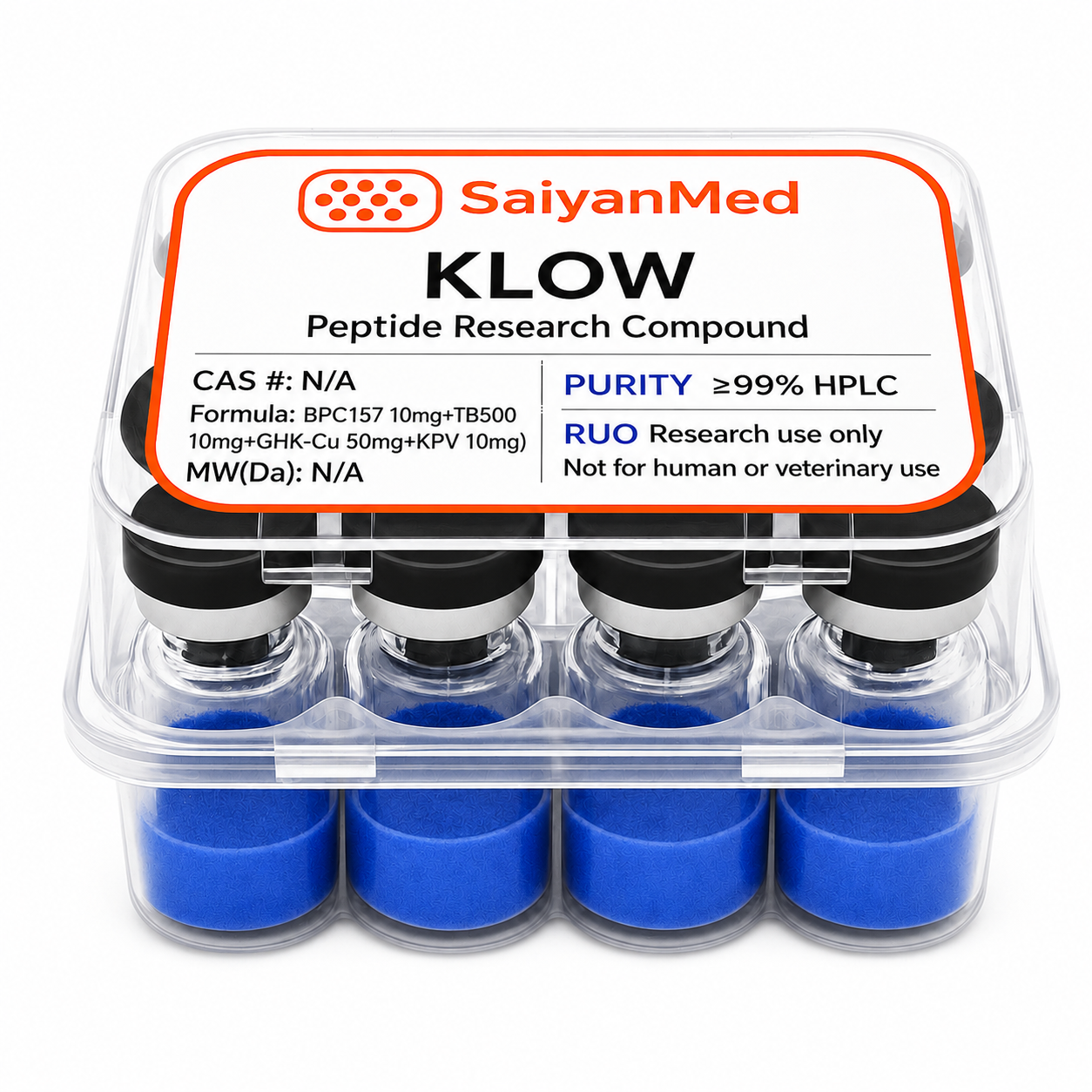
KLOW Stack brings together labelled BPC157, TB500, GHK-Cu and KPV components. Ingredient-level research connects this combination’s subject matter with matrix-related cell biology, copper–peptide chemistry and inflammatory-signaling models, while leaving the behavior of the four-component mixture open to direct study.
KPV transport and inflammatory signaling
Matrix-related ingredient research
Component identity and combination effects
Laboratory material
Research use only
RESEARCH CONTEXT
KPV transport and inflammatory signaling
Declared masses do not verify batch composition. Single-ingredient results do not prove synergy, anti-inflammatory efficacy, repair or cosmetic effects of the commercial stack; chemical forms and compatibility remain unspecified.
KLOW Stack
Batch-specific documentation
RUO
Research Context
KPV transport and inflammatory signaling
KPV is the Lys-Pro-Val tripeptide. A primary study examined PepT1-dependent uptake and NF-kappa-B/MAPK-related endpoints in intestinal epithelial and immune cell lines, alongside mouse colitis models. These are KPV-specific preclinical findings, not evidence for KLOW.
KPV transport and inflammatory signaling
Matrix-related ingredient research
Component identity and combination effects
What is KLOW Stack?
Commercial research combination of BPC157 10 mg, TB500 10 mg, GHK-Cu 50 mg and KPV 10 mg. The TB500 component is full-length thymosin beta-4 (43 aa, ~4963 Da, CAS 77591-33-4), not the Ac-LKKTETQ fragment. Mixture behavior is not characterized in this listing. KLOW Stack brings together labelled BPC157, TB500, GHK-Cu and KPV components. Ingredient-level research connects this combination’s subject matter with matrix-related cell biology, copper–peptide chemistry and inflammatory-signaling models, while leaving the behavior of the four-component mixture open to direct study.
BPC-157 and GHK-Cu have separate literatures involving tissue-model endpoints and matrix-related cellular biology. Their inclusion alongside KPV does not demonstrate a shared mechanism or a combined biological benefit. In analytical literature, “TB500” can refer to the acetylated fragment Ac-LKKTETQ (~889 Da). In this stack, TB500 denotes full-length 43-residue thymosin beta-4 (~4963 Da). A defined composition and direct combination experiment are prerequisites to interpreting interactions within KLOW.
Declared masses do not verify batch composition. Single-ingredient results do not prove synergy, anti-inflammatory efficacy, repair or cosmetic effects of the commercial stack; chemical forms and compatibility remain unspecified.
🧪 Research Applications
①
KPV transport and inflammatory signaling
KPV is the Lys-Pro-Val tripeptide. A primary study examined PepT1-dependent uptake and NF-kappa-B/MAPK-related endpoints in intestinal epithelial and immune cell lines, alongside mouse colitis models. These are KPV-specific preclinical findings, not evidence for KLOW.
②
Matrix-related ingredient research
BPC-157 and GHK-Cu have separate literatures involving tissue-model endpoints and matrix-related cellular biology. Their inclusion alongside KPV does not demonstrate a shared mechanism or a combined biological benefit.
③
Component identity and combination effects
In analytical literature, “TB500” can refer to the acetylated fragment Ac-LKKTETQ (~889 Da). In this stack, TB500 denotes full-length 43-residue thymosin beta-4 (~4963 Da). A defined composition and direct combination experiment are prerequisites to interpreting interactions within KLOW.
④
Analytical Characterization
Assess material identity, composition, and method suitability using documentation for the exact sample; published research does not certify the commercial lot.
⑤
Study Interpretation
Interpret experimental results within the tested model and endpoint. Constituent or reference-compound findings do not establish clinical effects of this material.
⑥
Material Traceability
Match laboratory records and any supplier report to the exact labeled material and lot.
📊 Quick Specs
Product: KLOW StackAvailable options: 80mg × 10 vialsDeclared components: BPC157 10 mg + TB500 10 mg + GHK-Cu 50 mg + KPV 10 mg.Declared total: 80 mg of named components per listed 80 mg vial; supplier declaration only.Declared mass ratio: BPC157 : TB500 : GHK-Cu : KPV = 1:1:5:1 (not a molar ratio).Listed pack: 80 mg × 10 vials.
Molecular parameters describe the stated reference chemical form; pack sizes and blend amounts are supplier declarations. The received lot label and SDS take precedence. Reference handling guidance is not a batch-purity certificate or a guaranteed shelf life.
Quality Documentation
Certificate of Analysis (COA)
A Certificate of Analysis records the identity checks, analytical methods and results reported for a specific sample or batch. Explore published quality reports in the SaiyanMed Trust Center.
For product or batch documentation enquiries, contact SaiyanMed with the product name and lot number, where available.
View Trust Center
Contact SaiyanMed
📦 Storage & Handling
Receipt & sealed storage
Inspect the vial and closure for leakage or damage before handling. Keep in its original labelled container, tightly closed and away from direct sunlight; keep separate from incompatible chemicals.
Before experimental mixing
Obtain the formulation-specific SDS, physical form and storage instructions before opening, diluting or combining with other materials. Do not assume compatibility from a product name; keep the supplied material separate until its composition and incompatibilities are established.
If confirmed as a dry peptide preparation
For a supplier-confirmed dry/lyophilized peptide only, let a cold sealed container reach ambient temperature in a desiccator before opening; work promptly and reseal tightly to limit moisture uptake.
Solutions and experimental handling
Choose a solvent only after component identity, terminal groups and assay compatibility are known. Avoid excessive warming during dissolution; do not infer long-term solution stability from dry-peptide guidance. Obtain mixture-specific instructions rather than applying a single-component freezer setting.
🚚 Fulfillment & Transit Notice
Global logistics: Orders ship from the nearest available warehouse. US-based warehouse fulfillment is available for domestic US orders; international orders ship from our Asian logistics hub with an estimated 7–14 day global delivery window. Delivery estimates may vary with destination, carrier and customs processing.
Temperature in transit: Follow the storage and handling guidance for the product’s supplied form upon arrival. Dry peptides, prepared solutions and liquid formulations have different handling requirements; contact us with the product and order reference if you have concerns about transit conditions.
Customs & duties: Cross-border research-chemical shipments may occasionally be subject to customs inspection or delay. Import duties and local customs requirements remain the responsibility of the consignee. A customs hold does not by itself indicate a product issue.
Delays or holds: If a shipment is delayed beyond the estimated window or held in customs, contact us with your order reference. We will assist with tracking and, where applicable, arrange a reshipment in line with our shipping policy.
Damaged or incorrect items: Please inspect your order on arrival. If a vial is damaged or an item is incorrect, contact us within the period stated in our shipping policy, with photos, for prompt resolution.
⚠️
Research Use Only
This material is supplied only for qualified laboratory research and is not intended for human or veterinary use.
Research Use Only
Not for Human Consumption
This listing is for laboratory research only. It is not intended for diagnostic, therapeutic, medical, disease-prevention, consumer-health, or personal use.
It is not for human consumption, medical treatment, diagnosis, disease prevention, or veterinary use.
✅ Buyer Confirmation
✓ You are a qualified researcher or acting under one’s supervision.
✓ The material will be used only for legitimate laboratory research.
✓ No human-use approval, efficacy, or safety claim is made for this listing.
✓ You are responsible for applicable laws and institutional procedures.
No Warranty: Product-specific identity, quality, safety, and suitability are not independently established by this page. Research outcomes and interpretations depend on the material and study design.
🛡️ General Safety & Handling
🚫 Not for Human Use
For qualified laboratory research only; not for human or veterinary administration.
🥽 PPE Required
Use appropriate personal protective equipment and institutional laboratory controls.
🌡 Follow Lot Documentation
Product-specific storage and stability details are not supplied on this listing.
🗑 Proper Disposal
Follow institutional biosafety and waste-disposal procedures.
🧾 Verify the Lot
Do not assume product identity or purity without batch-matched documentation.
⚖ Legal Compliance
Researchers are responsible for lawful possession and use in their jurisdiction.
💬 Frequently Asked Questions
Is KLOW the right choice if my main aim is to measure KPV’s contribution?+
KLOW is useful for a four-component mixture question, but a KLOW-only result cannot separate KPV’s contribution from those of the other ingredients. For a KPV-focused comparison, include a KPV-only material and a matched three-component control rather than relying on the stack alone.
Is KLOW simply a higher-strength version of GLOW?+
No—KLOW’s additional 10 mg is KPV, while the listed BPC157, TB500 and GHK-Cu amounts match GLOW’s. Choose by whether your experiment needs KPV, not by the larger total alone.
Can KLOW replace a KPV-only product at the same milligram amount?+
No—KLOW’s declared 80 mg total includes only 10 mg of KPV alongside three other components. Use KPV alone if you need to change its input without adding BPC157, TB500 and GHK-Cu.
Does KLOW’s 1:1:5:1 ratio mean equal amounts of three peptides and five times as many GHK-Cu molecules?+
That ratio describes the declared component masses, not molecule counts. For a molecule-matched comparison, calculate each component separately using its confirmed chemical form rather than treating the blend as one compound.
📚 References
Dalmasso et al.: PepT1-Mediated Tripeptide KPV Uptake Reduces Intestinal Inflammation
Read source ↗
Reference context only; not a certificate or batch test for this product.
Vasireddi et al.: Emerging Use of BPC-157 in Orthopaedic Sports Medicine
Read source ↗
Reference context only; not a certificate or batch test for this product.
Pickart: The human tri-peptide GHK and tissue remodeling
Read source ↗
Reference context only; not a certificate or batch test for this product.
Esposito et al. (naming background: the fragment called TB-500 in literature; not the form used in this stack)
Read source ↗
Reference context only; not a certificate or batch test for this product.
SaiyanMed archived KLOW Stack listing
Read source ↗
Reference context only; not a certificate or batch test for this product.
Specification & handling references
SaiyanMed archived product declaration
Technical reference ↗
CCOHS: Working safely with health-hazard products
Technical reference ↗
Bachem: Handling and Storage Guidelines for Peptides
Technical reference ↗
Reviews
There are no reviews yet.