Description
SaiyanMed Research Material
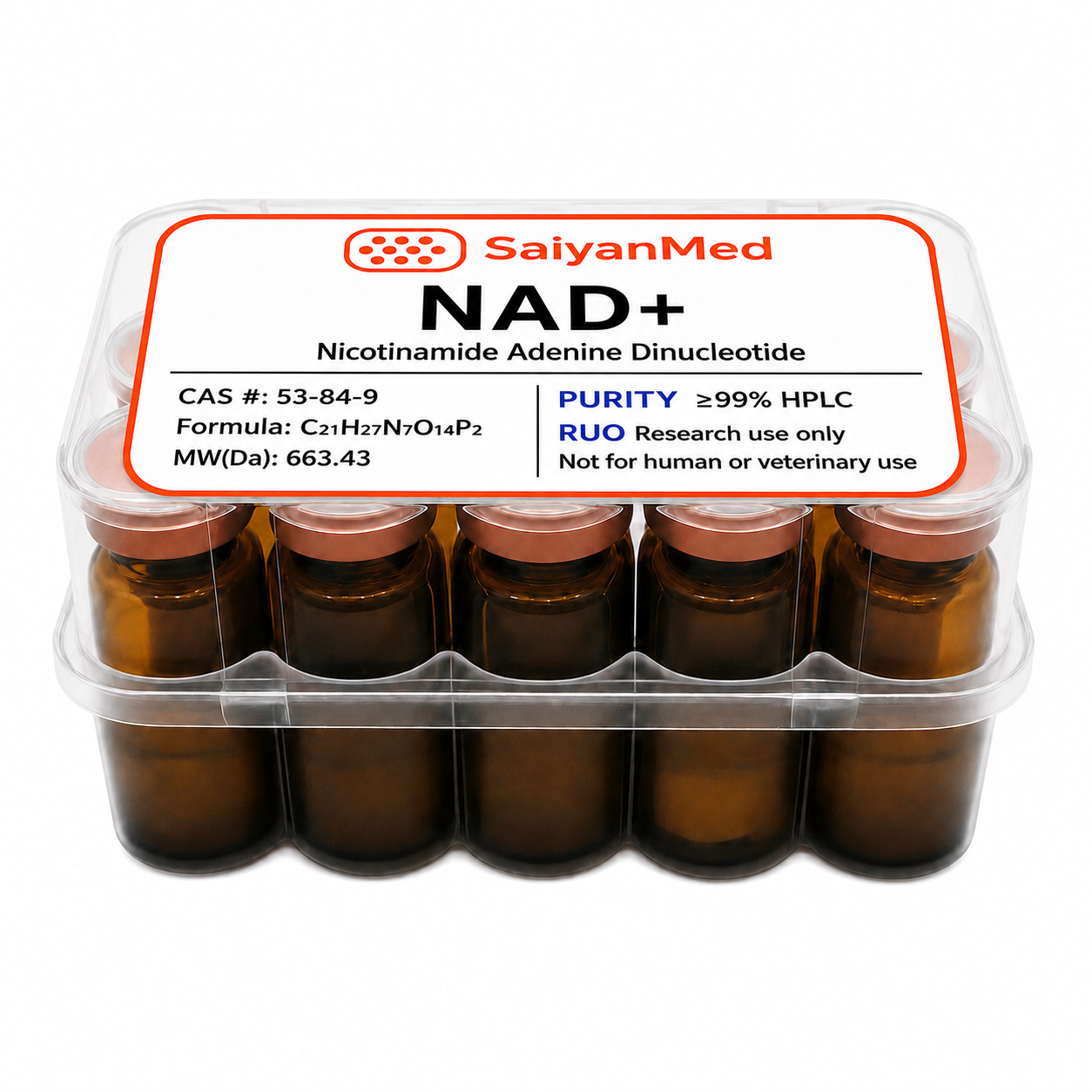
NAD+
Redox metabolism · NAD-consuming enzymes
NAD+ is the oxidized form of nicotinamide adenine dinucleotide, a cofactor studied in redox metabolism and NAD-consuming enzyme systems. Research topics include NAD+/NADH balance, cellular metabolic pathways and the distinct roles of nuclear, cytosolic and mitochondrial NAD pools.
NAD-consuming enzymes
Compartment-specific biology
Laboratory material
Research use only
RESEARCH CONTEXT
Redox metabolism
NAD+ is chemically distinct from NADH, NMN and NR, and the supplied salt is unspecified. Cellular and animal metabolism research does not establish longevity, anti-aging or human energy benefits for this material. The cited 2019 review supplies basic cofactor context rather than a current account of every transport mechanism.
Batch-specific documentation
RUO
Research Context
Redox metabolism
NAD+ accepts reducing equivalents to form NADH in metabolic reactions. NAD+/NADH measurements and pathway flux are related but are not interchangeable readouts.
NAD-consuming enzymes
Compartment-specific biology
What is NAD+?
NAD+ denotes oxidized nicotinamide adenine dinucleotide, a dinucleotide cofactor rather than a peptide. Product-specific salt, hydration state and formulation are not disclosed. NAD+ is the oxidized form of nicotinamide adenine dinucleotide, a cofactor studied in redox metabolism and NAD-consuming enzyme systems. Research topics include NAD+/NADH balance, cellular metabolic pathways and the distinct roles of nuclear, cytosolic and mitochondrial NAD pools.
PARPs, sirtuins and CD38 use NAD+ in different biochemical processes. Their enzyme activity and local substrate availability provide mechanistic research endpoints rather than a general measure of rejuvenation. NAD pools are regulated within cellular compartments. Whole-cell measurements cannot automatically resolve local changes, and adding extracellular NAD+ is not equivalent to manipulating a particular intracellular biosynthetic pathway.
NAD+ is chemically distinct from NADH, NMN and NR, and the supplied salt is unspecified. Cellular and animal metabolism research does not establish longevity, anti-aging or human energy benefits for this material. The cited 2019 review supplies basic cofactor context rather than a current account of every transport mechanism.
🧪 Research Applications
①
Redox metabolism
NAD+ accepts reducing equivalents to form NADH in metabolic reactions. NAD+/NADH measurements and pathway flux are related but are not interchangeable readouts.
②
NAD-consuming enzymes
PARPs, sirtuins and CD38 use NAD+ in different biochemical processes. Their enzyme activity and local substrate availability provide mechanistic research endpoints rather than a general measure of rejuvenation.
③
Compartment-specific biology
NAD pools are regulated within cellular compartments. Whole-cell measurements cannot automatically resolve local changes, and adding extracellular NAD+ is not equivalent to manipulating a particular intracellular biosynthetic pathway.
④
Analytical Characterization
Assess material identity, composition, and method suitability using documentation for the exact sample; published research does not certify the commercial lot.
⑤
Study Interpretation
Interpret experimental results within the tested model and endpoint. Constituent or reference-compound findings do not establish clinical effects of this material.
⑥
Material Traceability
Match laboratory records and any supplier report to the exact labeled material and lot.
📊 Quick Specs
Quality Documentation
Certificate of Analysis (COA)
A Certificate of Analysis records the identity checks, analytical methods and results reported for a specific sample or batch. Explore published quality reports in the SaiyanMed Trust Center.
For product or batch documentation enquiries, contact SaiyanMed with the product name and lot number, where available.
📦 Storage & Handling
Receipt & sealed storage
Inspect the vial and closure for leakage or damage before handling. Keep in its original labelled container, tightly closed and away from direct sunlight; keep separate from incompatible chemicals.
Before experimental mixing
Obtain the formulation-specific SDS, physical form and storage instructions before opening, diluting or combining with other materials. Do not assume compatibility from a product name; keep the supplied material separate until its composition and incompatibilities are established.
Reference crystalline free acid only
Cayman item 16077 specifies -20 °C storage for its crystalline NAD+ free-acid solid. This is a specific reference-material condition; it is not verified for an unspecified SaiyanMed salt, hydrate, liquid or formulated vial.
Aqueous research preparations — reference caution
Cayman advises against storing its aqueous NAD+ free-acid solution for more than one day. This supports preparing research solutions fresh under a validated protocol, not assigning a universal one-day stability or a product-specific beyond-use date.
🚚 Fulfillment & Transit Notice
Global logistics: Orders ship from the nearest available warehouse. US-based warehouse fulfillment is available for domestic US orders; international orders ship from our Asian logistics hub with an estimated 7–14 day global delivery window. Delivery estimates may vary with destination, carrier and customs processing.
Temperature in transit: Follow the storage and handling guidance for the product’s supplied form upon arrival. Dry peptides, prepared solutions and liquid formulations have different handling requirements; contact us with the product and order reference if you have concerns about transit conditions.
Customs & duties: Cross-border research-chemical shipments may occasionally be subject to customs inspection or delay. Import duties and local customs requirements remain the responsibility of the consignee. A customs hold does not by itself indicate a product issue.
Delays or holds: If a shipment is delayed beyond the estimated window or held in customs, contact us with your order reference. We will assist with tracking and, where applicable, arrange a reshipment in line with our shipping policy.
Damaged or incorrect items: Please inspect your order on arrival. If a vial is damaged or an item is incorrect, contact us within the period stated in our shipping policy, with photos, for prompt resolution.
⚠️
Research Use Only
This material is supplied only for qualified laboratory research and is not intended for human or veterinary use.
Research Use Only
Not for Human Consumption
This listing is for laboratory research only. It is not intended for diagnostic, therapeutic, medical, disease-prevention, consumer-health, or personal use.
It is not for human consumption, medical treatment, diagnosis, disease prevention, or veterinary use.
✅ Buyer Confirmation
✓ You are a qualified researcher or acting under one’s supervision.
✓ The material will be used only for legitimate laboratory research.
✓ No human-use approval, efficacy, or safety claim is made for this listing.
✓ You are responsible for applicable laws and institutional procedures.
No Warranty: Product-specific identity, quality, safety, and suitability are not independently established by this page. Research outcomes and interpretations depend on the material and study design.
🛡️ General Safety & Handling
🚫 Not for Human Use
For qualified laboratory research only; not for human or veterinary administration.
🥽 PPE Required
Use appropriate personal protective equipment and institutional laboratory controls.
🌡 Follow Lot Documentation
Product-specific storage and stability details are not supplied on this listing.
🗑 Proper Disposal
Follow institutional biosafety and waste-disposal procedures.
🧾 Verify the Lot
Do not assume product identity or purity without batch-matched documentation.
⚖ Legal Compliance
Researchers are responsible for lawful possession and use in their jurisdiction.
💬 Frequently Asked Questions
Should I choose NAD+, NADH or NMN for the same research assay?+
Choose according to the reaction: NAD+ is the oxidized cofactor, NADH is its reduced counterpart, and NMN is a biosynthetic precursor rather than a direct substitute for either. Match the assay’s specified substrate or cofactor; a precursor experiment asks a different question from supplying NAD+ directly.
Does the 1000 mg option have twice the NAD+ concentration of the 500 mg option?+
Those are listed masses, not mg/mL concentrations; concentration also depends on the solution volume. Compare options using the same chemical form and a defined volume rather than assuming the larger mass is twice as concentrated.
Does NAD+ free acid give the same amount of NAD+ per milligram as a salt or hydrate?+
Not necessarily—counterions and water of hydration change how weighed mass relates to the amount of NAD+. Confirm the supplied form before converting milligrams to moles or comparing products.
If NAD+ works in my cell-free enzyme assay, can I expect the same response in cells?+
Not automatically—supplying a cofactor directly to an isolated enzyme is different from adding it outside a cell with separately regulated NAD pools. Choose and validate the material for the actual model rather than carrying a cell-free result over to a cellular experiment.
📚 References
Zhu et al.: Subcellular compartmentalization of NAD+ and its role in cancer
Read source ↗
Reference context only; not a certificate or batch test for this product.
SaiyanMed archived NAD+ listing
Read source ↗
Reference context only; not a certificate or batch test for this product.
Specification & handling references
Technical reference ↗
Technical reference ↗
Technical reference ↗
Technical reference ↗
Reviews
There are no reviews yet.