Description
/* Reset & Base */
* {
box-sizing: border-box;
margin: 0;
padding: 0;
}
body {
font-family: ‘Inter’, -apple-system, BlinkMacSystemFont, ‘Segoe UI’, Roboto, Helvetica, Arial, sans-serif;
background: #fff;
color: #1e1e1e;
line-height: 1.6;
}
/* Utilities */
.sm-container {
max-width: 1300px;
margin: 0 auto;
padding: 20px 32px 60px;
width: 100%;
}
.sm-flex {
display: flex;
flex-wrap: wrap;
}
.sm-grid-2 {
display: grid;
grid-template-columns: 1fr 1fr;
gap: 40px;
}
.sm-grid-3 {
display: grid;
grid-template-columns: repeat(3, 1fr);
gap: 24px;
}
.sm-grid-4 {
display: grid;
grid-template-columns: repeat(4, 1fr);
gap: 20px;
}
/* Tabs */
.sm-tab-input {
display: none;
}
.sm-panel {
display: none;
}
#sm-tab-product:checked~.sm-tab-nav label[for=”sm-tab-product”],
#sm-tab-disclaimer:checked~.sm-tab-nav label[for=”sm-tab-disclaimer”] {
background: #F27444;
color: #fff;
border-color: #F27444;
box-shadow: 0 8px 20px rgba(242, 116, 68, 0.25);
}
#sm-tab-product:checked~.sm-product-panel {
display: block;
}
#sm-tab-disclaimer:checked~.sm-disclaimer-panel {
display: block;
}
/* FAQ */
.sm-faq summary::-webkit-details-marker {
display: none;
}
.sm-faq[open] .sm-plus {
transform: rotate(45deg);
}
/* Chips */
.sm-chip {
display: inline-block;
padding: 8px 16px;
border-radius: 999px;
background: #fff4ef;
border: 1px solid #ffd9cb;
color: #F27444;
font-weight: 600;
font-size: 0.9rem;
margin: 4px 6px 4px 0;
letter-spacing: 0.02em;
}
/* Cards & Hover */
.sm-card {
background: #fff;
border: 1px solid #f0e8e4;
border-radius: 28px;
padding: 28px;
transition: all 0.2s ease-in-out;
}
.sm-card:hover {
transform: translateY(-4px);
box-shadow: 0 20px 40px -12px rgba(0, 0, 0, 0.08);
border-color: #F27444;
}
.sm-card-glow {
background: linear-gradient(135deg, #fff 0%, #fff8f5 100%);
border: 1px solid #ffe1d6;
}
/* Specs Zebra */
.sm-spec-grid {
display: grid;
grid-template-columns: 1fr 1fr;
}
.sm-spec-item {
padding: 16px 24px;
border-bottom: 1px solid #f0e8e4;
background: #fff;
}
.sm-spec-item:nth-child(odd) {
background: #fcfaf9;
}
/* Responsive */
@media(max-width:768px) {
.sm-container {
padding: 20px 16px 40px;
}
.sm-grid-2,
.sm-grid-3,
.sm-grid-4 {
grid-template-columns: 1fr !important;
gap: 20px;
}
.sm-spec-grid {
grid-template-columns: 1fr;
}
.sm-tab {
width: 100% !important;
text-align: center !important;
}
.sm-hero-title {
font-size: 32px !important;
}
h2 {
font-size: 24px !important;
}
}
/* Misc */
.sm-tab {
font-size: 1rem;
padding: 12px 32px;
border-radius: 999px;
background: #fff;
border: 1px solid #e0d6d0;
color: #1e1e1e;
cursor: pointer;
font-weight: 600;
transition: all 0.2s;
user-select: none;
}
.sm-tab:hover {
background: #fff4ef;
border-color: #F27444;
}
.sm-hero-bg {
background: radial-gradient(ellipse at 70% 20%, rgba(242, 116, 68, 0.04) 0%, rgba(255, 255, 255, 0) 70%);
}
/* Reference list item hover */
.ref-item {
padding: 16px 20px;
background: #fff;
border-radius: 16px;
border: 1px solid #f0e8e4;
transition: all 0.2s ease-in-out;
}
.ref-item:hover {
border-color: #F27444;
box-shadow: 0 4px 12px rgba(242, 116, 68, 0.08);
}
.ref-item a {
color: #F27444;
font-weight: 700;
text-decoration: none;
}
.ref-item a:hover {
text-decoration: underline;
}
SaiyanMed Research Grade
Eloralintide Peptide
Next-generation selective amylin receptor agonist (AMY1R-selective) · research grade
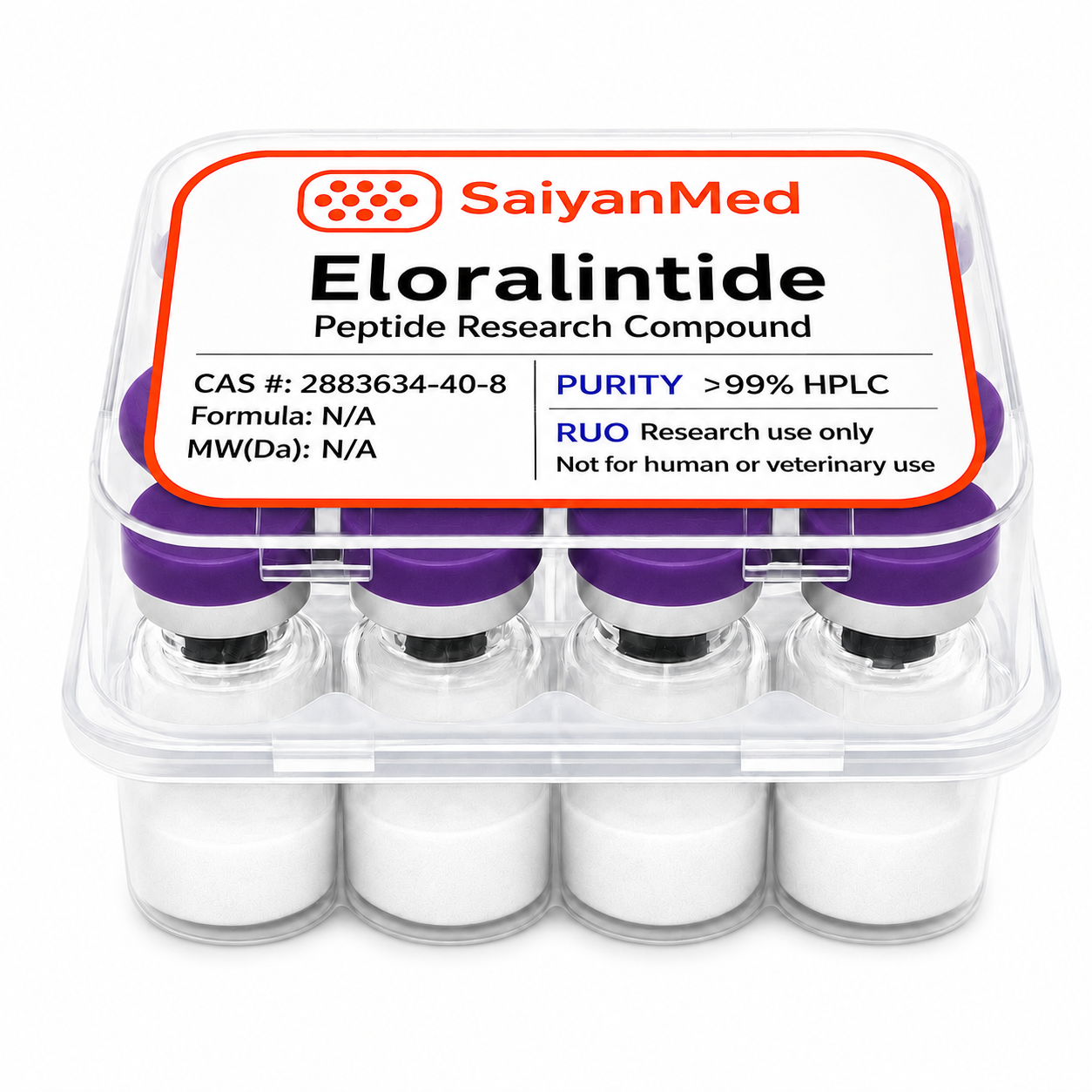
Research-grade Eloralintide is a synthetic selective amylin receptor agonist supplied for laboratory study of amylin-receptor signaling, satiety, and body-composition research models — a next-generation amylin mechanism distinct from GLP-1/GIP incretin agonists. Each vial is lyophilized, ≥99% HPLC pure, MS-confirmed, and supported by publicly verifiable third-party COAs published in our Trust Center. For research use only — not for human or veterinary use.
Background: What Is Eloralintide. Comparator note: Eloralintide vs Cagrilintide. Mechanism contrast (different receptor systems, not head-to-head): Eloralintide vs Retatrutide. For research use only — not for human or veterinary use.
≥99% HPLC
MS Confirmed
Third-Party COA
Lyophilized
Global Warehouse Fulfillment
Amylin Receptor Agonist
AMY1R · Selective Amylin Agonist
Designed for research models studying amylin-receptor signaling, satiety pathways, and body-composition endpoints — a next-generation mechanism distinct from GLP-1/GIP incretin agonists.
37 AA
CAS 2883634-40-8
RUO
Research Context
Mechanistic Study Tool
Eloralintide is positioned for mechanistic research into amylin-receptor signaling and satiety pathway modulation — a next-generation amylin mechanism distinct from GLP-1/GIP incretin agonists.
AMY1R Agonism
Satiety Research
Body Composition
What is Eloralintide?
Eloralintide is a synthetic, selective amylin receptor agonist. It is a C-terminally amidated linear polypeptide with a 37-amino-acid main chain (single L-enantiomer) in which the native amylin disulfide is replaced by a methylene thioacetal bridge between Cys2 and Cys7 to enhance chemical stability, and Lys26 is acylated with a side chain of two γ-glutamate residues and a saturated C20 fatty diacid that supports a long, once-weekly-compatible half-life.
In receptor assays it preferentially activates the human amylin-1 receptor (AMY1R) over the calcitonin receptor (CTR) and AMY3R — a selectivity profile that distinguishes it from non-selective amylin analogs such as cagrilintide.
It is studied in satiety, food-intake, and body-composition research models as a next-generation amylin mechanism, distinct from GLP-1 and GIP incretin agonists, and is being investigated both alone and in combination with incretin agonists.
🧪 Research Applications
①
Amylin-Receptor Selectivity
AMY1R vs AMY3R vs CTR activation and selectivity profiling in receptor assays.
②
Satiety & Food-Intake Models
Amylin-mediated satiety signaling and calorie-intake research models.
③
Body Composition (Fat vs Lean)
Fat-mass reduction with lean-mass preservation research endpoints.
④
Comparative Amylin Pharmacology
Eloralintide vs cagrilintide (selective vs non-selective) potency, PK, and tolerability research.
⑤
Incretin-Combination Research
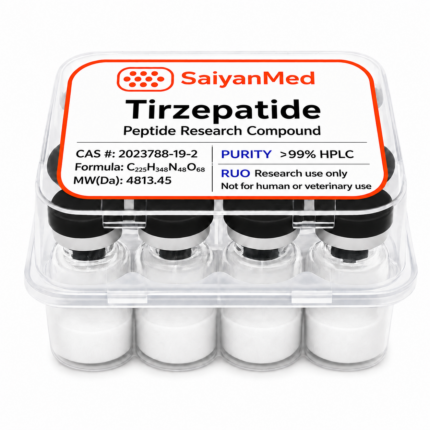
Amylin + incretin (e.g., tirzepatide) co-administration research models.
⑥
Long-Acting PK Profiling
C20-diacid acylation, albumin interaction, and extended half-life characterization.
📊 Quick Specs
Form: Lyophilized powder (white to off-white)
Purity: ≥99% by HPLC
Identity: MS molecular-weight confirmed (critical for this compound)
CAS Number: 2883634-40-8
Also Known As: “Elora”
Class: Selective amylin receptor agonist (AMY1R-selective)
Sequence Length: 37-amino-acid main chain (C-terminally amidated)
Molecular Formula: Not yet publicly disclosed — confirm per COA / MS
Molecular Weight: Not yet publicly disclosed — confirm per batch MS
Modification: Cys2–Cys7 methylene thioacetal bridge; Lys26 acylated (2× γ-Glu + C20 diacid)
Receptor Selectivity: human AMY1R > CTR (~12×) and > AMY3R (~11×)
Half-Life: ~13.9–15.8 days (Phase 1 MAD; long-acting, once-weekly compatible)
Peptide Type: Synthetic amylin analog (amylin mimetic)
COA: Third-party lab tested — publicly verifiable
Manufacture: Lyophilized & QC-released in-house
Storage: −20°C sealed | 2–8°C reconstituted
Shelf Life: 24 months unopened (lyophilized)
RUO: Research use only — not for human or veterinary use
VERIFIED
Certificate of Analysis
Independent Third-Party Validation
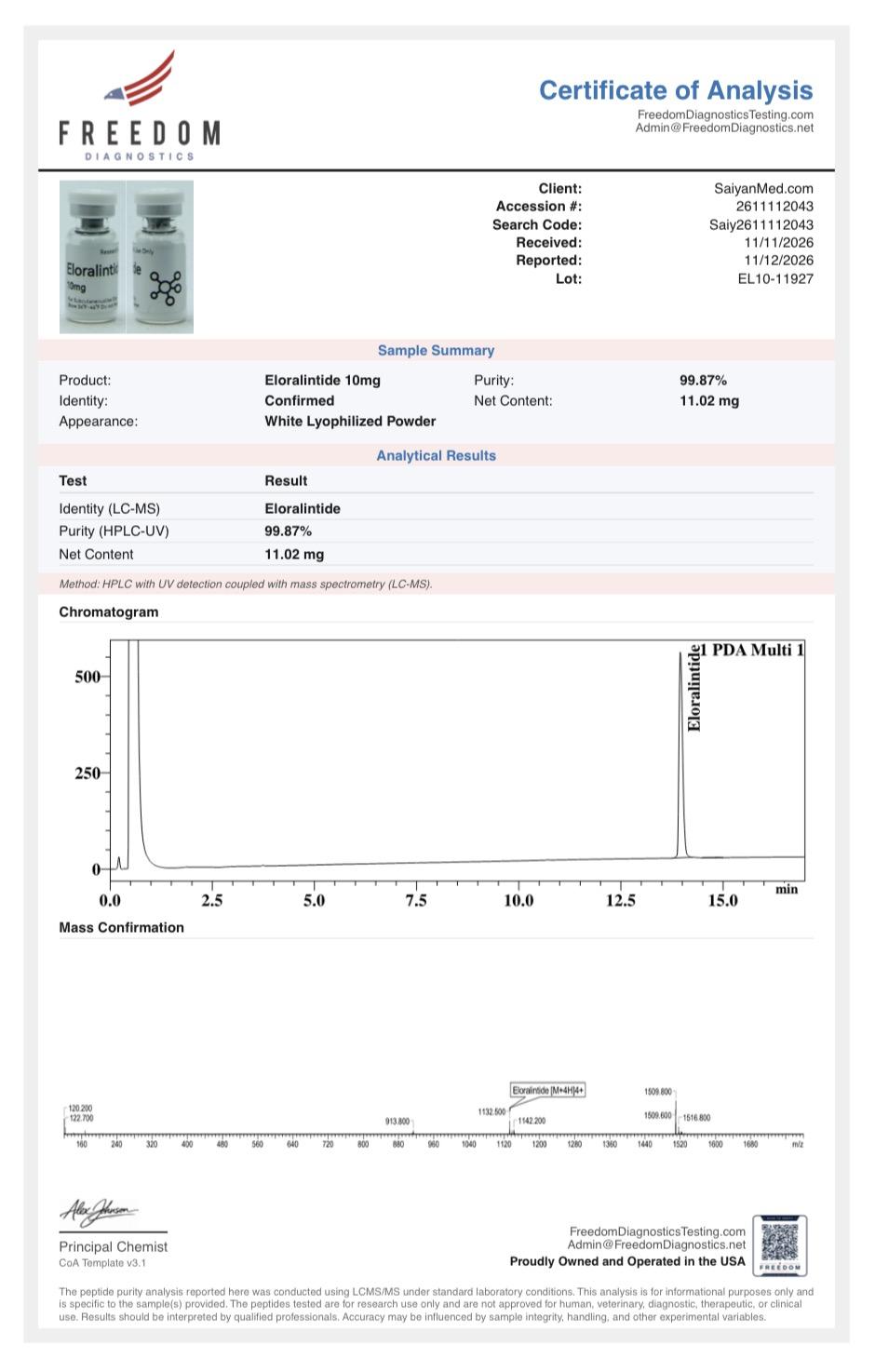
Transparency is central to our quality assurance. Batches undergo orthogonal analytical testing by an independent third-party laboratory. The resulting Certificate of Analysis (COA) details specific HPLC chromatograms and MS spectra for that lot. End‑users can cross‑validate the document online via the SaiyanMed Trust Center using the unique batch identifier printed on the vial label.
ⓘ For Eloralintide, the exact molecular formula and molecular weight are not publicly disclosed. The MS spectrum on the COA is therefore the critical evidence for correct identity confirmation — always verify the batch-specific MS data matches the expected value.
Batch‑specific documentation ensures full traceability for your laboratory records. Always confirm the batch reference matches the product vial before use.
📦 Storage & Handling
🧊 Storage
Lyophilized vials: store at −20°C, sealed, protected from light and moisture. After reconstitution: store at 2–8°C and use within 2–4 weeks (study-defined stability window). Avoid repeated freeze-thaw cycles. The modified Cys2–Cys7 methylene thioacetal bridge enhances chemical stability relative to native amylin, but standard peptide handling precautions still apply. Do not use if the reconstituted solution is cloudy or contains visible particles.
💧 Reconstitution
Add 1–2 mL of sterile diluent slowly down the inside wall of the vial. Do not shake or vortex; swirl gently until fully dissolved. The resulting solution should be clear and colorless. Prepare working dilutions according to your laboratory protocol.
🚚 Fulfillment & Transit Notice
Global logistics: To maintain structural integrity, lyophilized peptides are shipped in thermally insulated packaging. While in transit, the product remains stable at ambient temperatures for the typical 7–14 day window. Upon arrival, immediate refrigeration at −20°C is recommended.
Warehouse origin: We strategically ship from the nearest fulfillment center to reduce transit time. US orders are dispatched domestically; international orders ship from our China warehouse (estimated 7–14 business days).
Customs & duties: While we handle export documentation, import duties or customs inspections are standard procedures for research chemicals and remain the responsibility of the consignee. Delays due to customs are a normal part of international shipping and do not indicate a product issue.
Delays or holds: If your shipment exceeds the estimated window or is held in customs, contact us with your order reference. Our support team will intervene with tracking and carrier coordination, and where applicable, arrange a reshipment per our policy.
Damaged or incorrect items: Inspect your order immediately upon arrival. If a vial is damaged or an item is incorrect, contact us within the stated policy period with photos for prompt resolution.
⚠️
Research Use Only
This material is supplied only for qualified laboratory research and is not intended for human or veterinary use.
Research Use Only
Not for Human Consumption
SaiyanMed products are strictly for in vitro and in vivo laboratory research. They are not intended for diagnostic, therapeutic, medical, disease-prevention, consumer health, or personal use.
All SaiyanMed products are supplied for laboratory, scientific, and research use only. They are not for human consumption, medical treatment, diagnosis, disease prevention, or veterinary use.
✅ Buyer Confirmation
✓ You are a qualified researcher or acting under the supervision of one.
✓ Products will only be used for legitimate research purposes.
✓ Products are not evaluated by the FDA or any regulatory authority for human use.
✓ You assume responsibility for legal compliance, proper handling, storage, and disposal.
No Warranty: Products are sold “as is,” with no express or implied warranties regarding efficacy, safety, or suitability. Results in research may vary. SaiyanMed is not responsible for outcomes, interpretations, or conclusions drawn from any studies conducted using these products.
🛡️ General Safety & Handling
🚫 Not for Human Use
These compounds are for research only. Any off-label, personal, or clinical use is outside the intended scope.
🥽 PPE Required
Always use appropriate personal protective equipment, including gloves, lab coat, and eye protection.
🌡 Storage Compliance
Follow product-specific storage conditions to maintain identity, purity, and biological activity.
🗑 Proper Disposal
Dispose of all materials according to institutional biosafety, chemical waste, and hazardous material protocols.
🧾 Verify Quality
Verify batch identity, MS confirmation, HPLC purity, and COA status before research use.
⚖ Legal Compliance
Researchers are responsible for lawful purchase, possession, storage, and use in their jurisdiction.
💬 Frequently Asked Questions
What is Eloralintide used for?+
Eloralintide is supplied strictly as a research reference compound for in vitro and in vivo laboratory study of amylin-receptor signaling, satiety, and body-composition research models. It is not for human or veterinary use.
How is Eloralintide different from cagrilintide?+
Eloralintide is a selective amylin receptor agonist that preferentially activates AMY1R with low calcitonin-receptor activity (approximately 12-fold selective over CTR), whereas cagrilintide is a non-selective amylin analog. In research models this selectivity is studied for effects on tolerability and quality of weight change.
How is purity verified?+
Each production lot is subjected to quantitative HPLC (≥99% purity) and high‑resolution mass spectrometry for identity confirmation. A third-party COA is published for tested batches and is independently verifiable online via the batch‑specific identifier.
How should it be stored?+
Lyophilized vials should be kept at −20°C, away from light and moisture. After reconstitution with sterile diluent, store at 2–8°C and use within 2–4 weeks. Avoid repeated freeze‑thaw cycles. The methylene thioacetal bridge between Cys2 and Cys7 enhances chemical stability relative to native amylin.
Where does it ship from?+
Orders are dispatched from the nearest available warehouse – US domestic orders from our US fulfillment center, international orders from our China warehouse. Estimated delivery is 7–14 days for global shipments, with tracking provided.
Is this intended for human use?+
No. This material is strictly for laboratory research use only and is not intended for human consumption, diagnosis, treatment, disease prevention, or any personal use. It is not a pharmaceutical product.
📚 References
PubChem:
Eloralintide — search by CAS 2883634-40-8.
Search PubChem by CAS ↗
PubMed (National Library of Medicine):
Search results for “eloralintide” — comprehensive index of published research.
Search PubMed ↗
Briere DA, et al. (2025):
Eloralintide, a novel amylin receptor agonist for the treatment of obesity: From discovery to clinical proof of concept.
Molecular Metabolism 102:102271. (Selectivity: AMY1R > CTR ~12×, > AMY3R ~11×; Phase 1 PK supports once-weekly dosing).
View at PubMed ↗
Bhattachar S, et al. (2026):
Eloralintide, a selective, long-acting amylin receptor agonist for treatment of obesity: Phase 1 proof of concept.
Diabetes Obes Metab 28(4):2651-2660. (Half-life ~13.9–15.8 days).
View at PubMed ↗
Billings LK, et al. (2025):
Eloralintide, a selective amylin receptor agonist for the treatment of obesity: a 48-week phase 2 trial.
Lancet 406(10520):2631-2643. (NCT06230523).
View at PubMed ↗
TargetMol:
Eloralintide — CAS 2883634-40-8 (Note: molecular formula and weight are not officially confirmed; refer to batch COA for MS-verified data).
View at TargetMol ↗
Reviews
There are no reviews yet.