Description
SaiyanMed Research Material
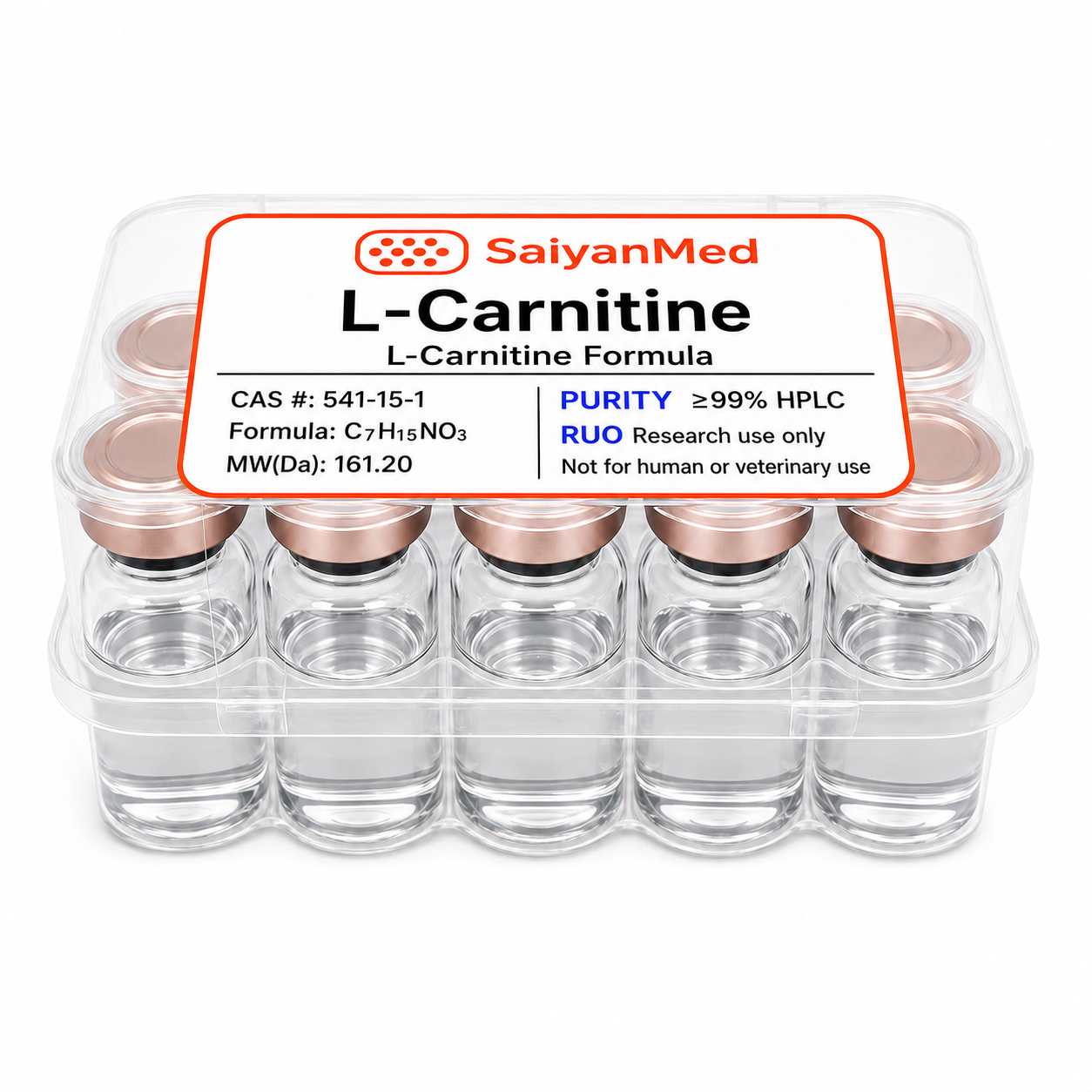
L-Carnitine
The carnitine shuttle · Transport versus metabolic readouts
L-Carnitine is a small-molecule metabolite central to carnitine-shuttle research. Its biochemical context includes long-chain fatty-acyl transport into mitochondria, acylcarnitine metabolism and the relationship between substrate transport and fatty-acid oxidation.
Transport versus metabolic readouts
Free and acylated carnitine species
Laboratory material
Research use only
RESEARCH CONTEXT
The carnitine shuttle
L-carnitine is not a peptide, and the supplied salt form is unspecified. Its role in metabolic pathways does not establish fat loss, energy enhancement or benefits from human supplementation with this material.
Batch-specific documentation
RUO
Research Context
The carnitine shuttle
Long-chain fatty-acyl entry into mitochondria involves CPT1, carnitine–acylcarnitine translocase and CPT2. These steps connect carnitine-dependent transport with downstream beta-oxidation without making carnitine itself an oxidation enzyme.
Transport versus metabolic readouts
Free and acylated carnitine species
What is L-Carnitine?
L-carnitine is an amino-acid-derived quaternary ammonium metabolite, not a peptide or a protein-building amino acid. This listing does not define its salt or formulation. L-Carnitine is a small-molecule metabolite central to carnitine-shuttle research. Its biochemical context includes long-chain fatty-acyl transport into mitochondria, acylcarnitine metabolism and the relationship between substrate transport and fatty-acid oxidation.
Acylcarnitine profiles, substrate oxidation and respiration address related but distinct questions. Changes in overall oxygen consumption do not by themselves measure CPT1 activity or demonstrate increased fatty-acid flux. Free carnitine and individual acylcarnitines are distinct analytical species. Their relative abundance can inform studies of acyl-group handling, but an acylcarnitine pattern alone does not establish a clinical metabolic benefit.
L-carnitine is not a peptide, and the supplied salt form is unspecified. Its role in metabolic pathways does not establish fat loss, energy enhancement or benefits from human supplementation with this material.
🧪 Research Applications
①
The carnitine shuttle
Long-chain fatty-acyl entry into mitochondria involves CPT1, carnitine–acylcarnitine translocase and CPT2. These steps connect carnitine-dependent transport with downstream beta-oxidation without making carnitine itself an oxidation enzyme.
②
Transport versus metabolic readouts
Acylcarnitine profiles, substrate oxidation and respiration address related but distinct questions. Changes in overall oxygen consumption do not by themselves measure CPT1 activity or demonstrate increased fatty-acid flux.
③
Free and acylated carnitine species
Free carnitine and individual acylcarnitines are distinct analytical species. Their relative abundance can inform studies of acyl-group handling, but an acylcarnitine pattern alone does not establish a clinical metabolic benefit.
④
Analytical Characterization
Assess material identity, composition, and method suitability using documentation for the exact sample; published research does not certify the commercial lot.
⑤
Study Interpretation
Interpret experimental results within the tested model and endpoint. Constituent or reference-compound findings do not establish clinical effects of this material.
⑥
Material Traceability
Match laboratory records and any supplier report to the exact labeled material and lot.
📊 Quick Specs
Quality Documentation
Certificate of Analysis (COA)
A Certificate of Analysis records the identity checks, analytical methods and results reported for a specific sample or batch. Explore published quality reports in the SaiyanMed Trust Center.
For product or batch documentation enquiries, contact SaiyanMed with the product name and lot number, where available.
📦 Storage & Handling
Receipt & sealed storage
Inspect the vial and closure for leakage or damage before handling. Keep in its original labelled container, tightly closed and away from direct sunlight; keep separate from incompatible chemicals.
Before experimental mixing
Obtain the formulation-specific SDS, physical form and storage instructions before opening, diluting or combining with other materials. Do not assume compatibility from a product name; keep the supplied material separate until its composition and incompatibilities are established.
Reference crystalline material only
Cayman item 21489 specifies room-temperature storage for its crystalline L-carnitine solid. Apply this only as reference-material context, not as verified storage for the supplied vial whose physical form, salt and formulation are unconfirmed.
Aqueous research preparations — reference caution
Cayman discourages keeping its aqueous L-carnitine solutions for more than one day. This is a manufacturer precaution for that reference material, not a measured one-day lifetime or an opened-vial expiry for this product; use a formulation-specific laboratory protocol.
🚚 Fulfillment & Transit Notice
Global logistics: Orders ship from the nearest available warehouse. US-based warehouse fulfillment is available for domestic US orders; international orders ship from our Asian logistics hub with an estimated 7–14 day global delivery window. Delivery estimates may vary with destination, carrier and customs processing.
Temperature in transit: Follow the storage and handling guidance for the product’s supplied form upon arrival. Dry peptides, prepared solutions and liquid formulations have different handling requirements; contact us with the product and order reference if you have concerns about transit conditions.
Customs & duties: Cross-border research-chemical shipments may occasionally be subject to customs inspection or delay. Import duties and local customs requirements remain the responsibility of the consignee. A customs hold does not by itself indicate a product issue.
Delays or holds: If a shipment is delayed beyond the estimated window or held in customs, contact us with your order reference. We will assist with tracking and, where applicable, arrange a reshipment in line with our shipping policy.
Damaged or incorrect items: Please inspect your order on arrival. If a vial is damaged or an item is incorrect, contact us within the period stated in our shipping policy, with photos, for prompt resolution.
⚠️
Research Use Only
This material is supplied only for qualified laboratory research and is not intended for human or veterinary use.
Research Use Only
Not for Human Consumption
This listing is for laboratory research only. It is not intended for diagnostic, therapeutic, medical, disease-prevention, consumer-health, or personal use.
It is not for human consumption, medical treatment, diagnosis, disease prevention, or veterinary use.
✅ Buyer Confirmation
✓ You are a qualified researcher or acting under one’s supervision.
✓ The material will be used only for legitimate laboratory research.
✓ No human-use approval, efficacy, or safety claim is made for this listing.
✓ You are responsible for applicable laws and institutional procedures.
No Warranty: Product-specific identity, quality, safety, and suitability are not independently established by this page. Research outcomes and interpretations depend on the material and study design.
🛡️ General Safety & Handling
🚫 Not for Human Use
For qualified laboratory research only; not for human or veterinary administration.
🥽 PPE Required
Use appropriate personal protective equipment and institutional laboratory controls.
🌡 Follow Lot Documentation
Product-specific storage and stability details are not supplied on this listing.
🗑 Proper Disposal
Follow institutional biosafety and waste-disposal procedures.
🧾 Verify the Lot
Do not assume product identity or purity without batch-matched documentation.
⚖ Legal Compliance
Researchers are responsible for lawful possession and use in their jurisdiction.
💬 Frequently Asked Questions
Can free L-carnitine inner salt and L-carnitine tartrate be substituted milligram for milligram?+
No—the tartrate contributes to the weighed mass, so equal milligrams do not represent equal amounts of L-carnitine. For a matched research comparison, confirm the supplied chemical form and compare L-carnitine equivalents while accounting for the additional counterion in the assay.
Can I use acetyl-L-carnitine instead of L-carnitine in the same experiment?+
Acetyl-L-carnitine is an acylated carnitine species, not just another salt of free L-carnitine. Match the species specified by your assay rather than replacing one with the other on equal milligrams.
If I buy the larger L-carnitine strength, does that mean twice the solution concentration?+
A larger listed mass does not establish a higher mg/mL concentration without a defined solution volume. Compare the chemical form, L-carnitine-equivalent amount and any stated volume before treating two options as concentration equivalents.
Should I choose L-carnitine alone or Lipo-C + B12 for a carnitine-focused experiment?+
Choose a defined L-carnitine material if you need to isolate carnitine’s contribution. The Lipo-C name does not establish a carnitine amount, and additional blend ingredients would introduce other experimental variables.
📚 References
Mahé et al.: Genetics of enzymatic dysfunctions in metabolic disorders and cancer
Read source ↗
Reference context only; not a certificate or batch test for this product.
SaiyanMed archived L-Carnitine listing
Read source ↗
Reference context only; not a certificate or batch test for this product.
Specification & handling references
Technical reference ↗
Technical reference ↗
Technical reference ↗
Technical reference ↗
Reviews
There are no reviews yet.