Description
/* Reset & Base */
* { box-sizing: border-box; margin: 0; padding: 0; }
body {
font-family: ‘Inter’, -apple-system, BlinkMacSystemFont, ‘Segoe UI’, Roboto, Helvetica, Arial, sans-serif;
background: #fff; color: #1e1e1e; line-height: 1.6;
}
.sm-container { max-width: 1300px; margin: 0 auto; padding: 20px 32px 60px; width: 100%; }
.sm-flex { display: flex; flex-wrap: wrap; }
.sm-grid-2 { display: grid; grid-template-columns: 1fr 1fr; gap: 40px; }
.sm-grid-3 { display: grid; grid-template-columns: repeat(3, 1fr); gap: 24px; }
.sm-grid-4 { display: grid; grid-template-columns: repeat(4, 1fr); gap: 20px; }
.sm-tab-input { display: none; }
.sm-panel { display: none; }
#sm-tab-product-ghkcu:checked~.sm-tab-nav label[for=”sm-tab-product-ghkcu”],
#sm-tab-disclaimer-ghkcu:checked~.sm-tab-nav label[for=”sm-tab-disclaimer-ghkcu”] {
background: #F27444; color: #fff; border-color: #F27444;
box-shadow: 0 8px 20px rgba(242, 116, 68, 0.25);
}
#sm-tab-product-ghkcu:checked~.sm-product-panel { display: block; }
#sm-tab-disclaimer-ghkcu:checked~.sm-disclaimer-panel { display: block; }
.sm-faq summary::-webkit-details-marker { display: none; }
.sm-faq[open] .sm-plus { transform: rotate(45deg); }
.sm-chip {
display: inline-block; padding: 8px 16px; border-radius: 999px;
background: #fff4ef; border: 1px solid #ffd9cb; color: #F27444;
font-weight: 600; font-size: 0.9rem; margin: 4px 6px 4px 0; letter-spacing: 0.02em;
}
.sm-card {
background: #fff; border: 1px solid #f0e8e4; border-radius: 28px; padding: 28px;
transition: all 0.2s ease-in-out;
}
.sm-card:hover {
transform: translateY(-4px);
box-shadow: 0 20px 40px -12px rgba(0, 0, 0, 0.08);
border-color: #F27444;
}
.sm-card-glow {
background: linear-gradient(135deg, #fff 0%, #fff8f5 100%);
border: 1px solid #ffe1d6;
}
.sm-spec-grid { display: grid; grid-template-columns: 1fr 1fr; }
.sm-spec-item { padding: 16px 24px; border-bottom: 1px solid #f0e8e4; background: #fff; }
.sm-spec-item:nth-child(odd) { background: #fcfaf9; }
@media(max-width:768px) {
.sm-container { padding: 20px 16px 40px; }
.sm-grid-2, .sm-grid-3, .sm-grid-4 { grid-template-columns: 1fr !important; gap: 20px; }
.sm-spec-grid { grid-template-columns: 1fr; }
.sm-tab { width: 100% !important; text-align: center !important; }
.sm-hero-title { font-size: 32px !important; }
h2 { font-size: 24px !important; }
}
.sm-tab {
font-size: 1rem; padding: 12px 32px; border-radius: 999px; background: #fff;
border: 1px solid #e0d6d0; color: #1e1e1e; cursor: pointer; font-weight: 600;
transition: all 0.2s; user-select: none;
}
.sm-tab:hover { background: #fff4ef; border-color: #F27444; }
.sm-hero-bg {
background: radial-gradient(ellipse at 70% 20%, rgba(242, 116, 68, 0.04) 0%, rgba(255, 255, 255, 0) 70%);
}
.sm-inline-link {
color: #F27444; font-weight: 700; text-decoration: underline; text-underline-offset: 2px;
}
.sm-note { color: #666; font-size: 0.9rem; line-height: 1.7; }
.ref-item {
padding: 16px 20px; background: #fff; border-radius: 16px; border: 1px solid #f0e8e4;
transition: all 0.2s ease-in-out;
}
.ref-item:hover { border-color: #F27444; box-shadow: 0 4px 12px rgba(242, 116, 68, 0.08); }
.ref-item a { color: #F27444; font-weight: 700; text-decoration: none; }
.ref-item a:hover { text-decoration: underline; }
SaiyanMed Research Grade
GHK-Cu
Copper Tripeptide-1 · Prezatide copper · Gly-His-Lys · Cu(II)
10-Vial Kit · Copper-binding tripeptide complex
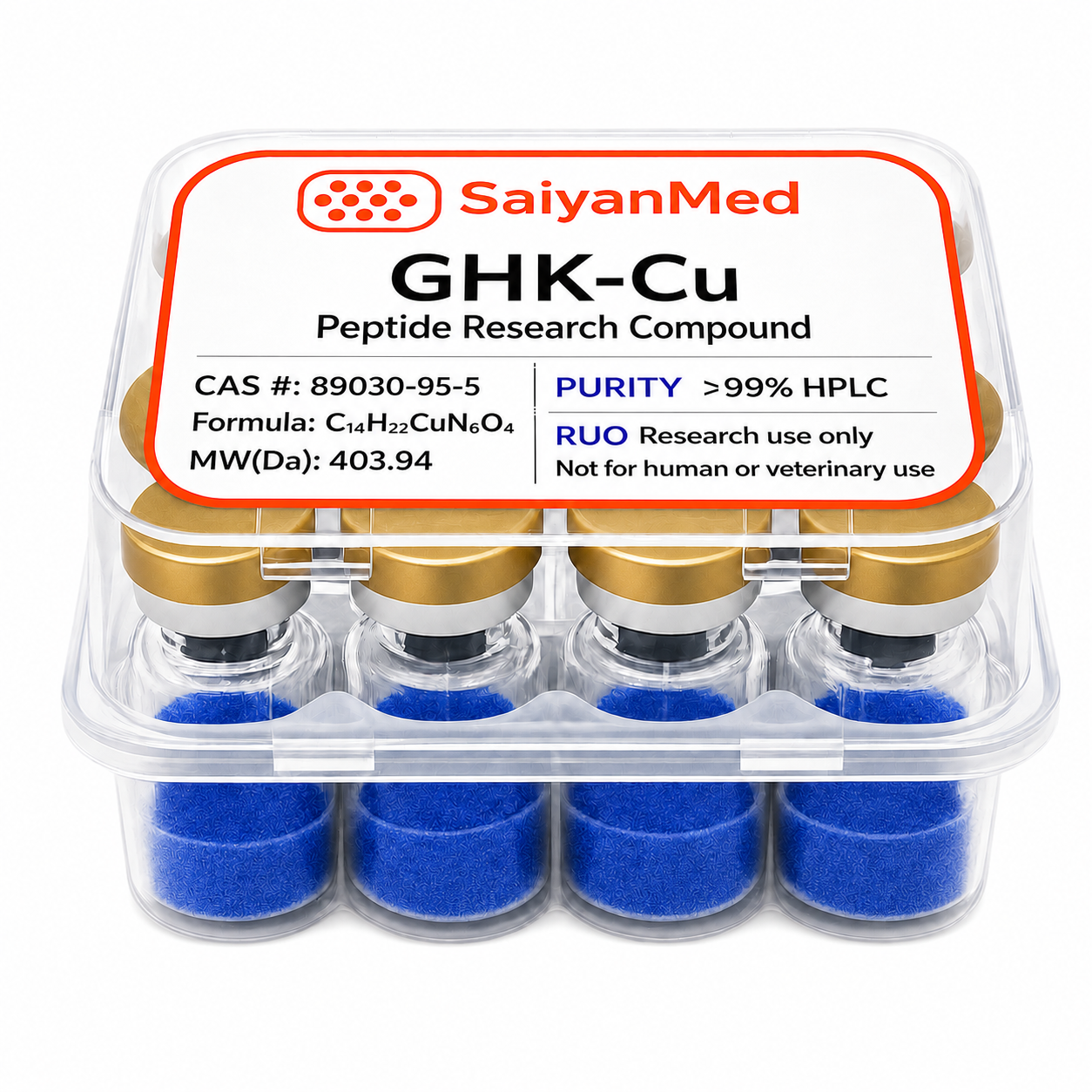
Research-grade GHK-Cu (Copper Tripeptide-1, CAS 89030-95-5) is the copper(II) complex of the tripeptide glycyl-L-histidyl-L-lysine (Gly-His-Lys). It is supplied as a lyophilized reference material for laboratory studies of copper–peptide coordination chemistry, extracellular-matrix (ECM) gene-expression models, fibroblast biology, and related peptide analytics. Each vial is supplied to a SaiyanMed specification of ≥99% HPLC purity with mass-spectrometry identity confirmation and a batch-specific, independently verifiable third-party COA. For research use only — not for cosmetic application, human use, or veterinary use.
≥99% HPLC Spec.
MS Confirmed
Third-Party COA
Lyophilized
10-Vial Kit
COPPER(II)–TRIPEPTIDE COMPLEX
Gly-His-Lys · Cu2+
Positioned for analytical, coordination-chemistry, and cell-culture research involving the 1:1 GHK–copper complex. Descriptions of ECM remodeling or gene-expression changes refer to published experimental models and are not claims of cosmetic or clinical outcome for this vial.
3 AA + Cu
CAS 89030-95-5
RUO
~402.9 Da*
Research Context
Copper–Peptide Research Tool
GHK-Cu is used in laboratory work on copper coordination, peptide identity/analytics, fibroblast and ECM gene-expression models, angiogenesis pathway assays, and hair-follicle biology models. It is not offered as a finished cosmetic, injectable, topical treatment, medicine, or personal-use product.
Cu Coordination
ECM Models
Peptide Analytics
What is GHK-Cu?
GHK-Cu (also indexed as Copper Tripeptide-1 / prezatide copper) is the copper(II) complex of Gly-His-Lys. The free tripeptide without copper is a distinct substance (commonly CAS 49557-75-7). SaiyanMed lists this research material under CAS 89030-95-5 for the copper complex. Catalog identity uses the formula representation C14H23CuN6O4+ with an approximate molecular weight of 402.92 g/mol (PubChem CID 71587328 protonated-form record). Neutral 1:1 complex formulae of C14H22CuN6O4 (~401.91 g/mol) also appear in the literature; researchers should treat batch MS data and the vial label as controlling identity documentation.
In experimental systems, GHK-Cu has been studied in relation to copper delivery, metalloprotein interactions, and modulation of gene-expression programs associated with extracellular-matrix components (including collagen- and elastin-related transcripts in fibroblast models). Angiogenesis and hair-follicle biology appear in the research literature as additional model contexts. Those findings describe laboratory observations; they are not instructions for skin care, wound treatment, hair restoration, or any human application of this SaiyanMed vial.
Salt form, hydration, and counter-ion content (for example acetate from purification) can shift the observed mass of a lyophilized powder relative to the anhydrous complex formula. Confirm expected mass and chromatographic purity against the lot-specific third-party report before research use.
🧪 Research Applications
①
Copper–Peptide Coordination
Studies of Cu(II) binding to Gly-His-Lys, speciation, and spectroscopic or chromatographic characterization of the complex.
②
Peptide Identity & Analytics
HPLC, LC–MS, retention-time, and reference-standard work for Copper Tripeptide-1 lots.
③
Fibroblast / ECM Gene Models
In vitro assays examining ECM-related transcript or protein readouts in cultured fibroblast systems.
④
Angiogenesis Pathway Assays
Laboratory models investigating copper- and peptide-linked angiogenic signaling pathways.
⑤
Hair-Follicle Biology Models
Research contexts involving follicular cell systems; not a claim of hair-growth outcomes.
⑥
Formulation & Stability Research
Compatibility, recovery, oxidation/hydrolysis, and storage studies for copper–peptide materials.
📊 Quick Specs
Form: Lyophilized powder (typically blue to blue-violet / off-white depending on lot)
Purity Specification: ≥99% by HPLC — batch-specific
Identity: Molecular-weight confirmation by MS — batch-specific
CAS Number: 89030-95-5 (copper complex)
INCI / Synonyms: Copper Tripeptide-1 · Prezatide copper · GHK-Cu
Sequence / Ligand: Gly-His-Lys · Cu(II) (1:1 complex intent)
Molecular Formula (catalog): C14H23CuN6O4+*
Molecular Weight (catalog): ~402.92 g/mol*
Related Free Peptide CAS: 49557-75-7 (GHK without copper — distinct material)
Research Context: Copper coordination · ECM / fibroblast models · peptide analytics
Kit Options: 50 mg × 10 vials · 100 mg × 10 vials (as listed on product)
COA / Report: Third-party lab tested — batch-specific, independently verifiable
Manufacture: Lyophilized and QC-released under SaiyanMed procedures
Storage: −20°C sealed; after reconstitution use a validated in-use window
Shelf Life: 24 months unopened, subject to label and lot documentation
Intended Use: Laboratory research only; not for cosmetic, human, or veterinary use
*Public records for GHK-Cu report more than one charge state / formula (e.g., neutral C14H22CuN6O4 ≈ 401.91 g/mol vs protonated C14H23CuN6O4+ ≈ 402.92 g/mol). SaiyanMed catalog identity follows CAS 89030-95-5 with the ~402.92 g/mol representation; confirm against lot MS and label. Purity, third-party lab documentation, kit sizes, and warehouse statements are SaiyanMed product specifications.
VERIFIED
Certificate of Analysis
Independent Third-Party Validation
Transparency is central to SaiyanMed quality documentation. Each released batch is supported by HPLC and mass-spectrometry documentation and, where published, a batch-specific third-party analytical report. Verify the report through the SaiyanMed Trust Center using the report key or QR code supplied with the lot.
A verification result confirms the report record associated with the submitted key; it does not independently prove chain of custody between a webpage, vial, and tested sample. Confirm that the product name, expected mass, batch identifier, vial label, and report details agree before research use.
📦 Storage & Handling
🧊 Storage
Keep sealed lyophilized vials at −20°C, protected from light and moisture. Avoid repeated freeze–thaw cycles. After reconstitution, use the solvent, temperature, container, and in-use period validated for the specific assay and batch. SaiyanMed’s common short-term handling range is 2–8°C; treat any multi-week window as study-defined. Do not use a solution that is unexpectedly cloudy, particulate, or inconsistent with lot documentation.
💧 Laboratory Reconstitution
Select a laboratory-grade solvent compatible with the intended assay and the material’s documented salt form. Add the calculated volume slowly down the vial wall, then swirl gently; do not shake or vortex. Define final concentration, pH, and solvent composition in the research protocol. This guidance is for laboratory preparation only and is not an instruction for topical application, injection, or administration to people or animals.
🚚 Fulfillment & Transit Notice
Fulfillment: Orders are dispatched from the nearest available fulfillment location. Domestic U.S. orders may be fulfilled from a U.S.-based warehouse; international orders may ship from SaiyanMed’s China warehouse. Estimated international delivery is generally 7–14 business days, subject to carrier and customs conditions.
Temperature in transit: Lyophilized format is used to support transport stability. Store at −20°C promptly on arrival. Extended or extreme excursions should be assessed against lot-specific stability and analytical data before use.
Customs handling: Cross-border research-material shipments may be inspected or delayed. Import authorization, duties, possession, and lawful research use remain the consignee’s responsibility.
Delays or holds: Contact SaiyanMed with the order reference if transit exceeds the published window or the shipment is held.
Damaged or incorrect items: Inspect the package immediately. Report damage, label discrepancies, or incorrect items within the policy period and retain photographs and packaging for review.
⚠️
Research Use Only
This material is supplied only for qualified laboratory research and is not intended for cosmetic application, human use, or veterinary use.
Research Use Only
Not a Finished Cosmetic or Personal-Use Product
SaiyanMed GHK-Cu is supplied strictly for lawful laboratory research. It is not intended for injection, ingestion, inhalation, topical application to people, cosmetic treatment, diagnosis, therapy, disease prevention, or veterinary use.
Discussion of ECM remodeling, collagen/elastin gene expression, angiogenesis, or hair-follicle biology describes research context only. It must not be interpreted as a claim of wrinkle reduction, skin rejuvenation, wound healing in people, hair growth, clinical safety, or suitability for use on people or animals.
✅ Buyer Confirmation
✓ You are a qualified researcher or are acting under appropriate institutional supervision.
✓ The material will be used only for legitimate, lawful laboratory research.
✓ This SaiyanMed product is not a finished cosmetic, medicine, injectable, or product approved for human use.
✓ You accept responsibility for legal compliance, risk assessment, handling, storage, and disposal.
No Warranty of Biological Outcome: The material is supplied “as is” for research. No warranty is made regarding cosmetic benefit, biological efficacy, safety, fitness for a specific assay, or reproducibility outside the stated analytical specifications.
🛡️ General Safety & Handling
🚫 No Personal Use
Do not ingest, inject, inhale, apply to skin, or otherwise administer this research material to people or animals.
🥽 Laboratory Controls
Use an institutional risk assessment, suitable engineering controls, and appropriate personal protective equipment.
🌡 Storage Compliance
Follow the batch label, analytical report, laboratory SOPs, and validated storage conditions.
🗑 Proper Disposal
Dispose of material and contaminated consumables under institutional chemical and biological waste procedures.
🧾 Verify the Lot
Confirm expected mass, mass spectrum, HPLC result, report key, and label consistency before research use.
⚖ Legal Compliance
Researchers are responsible for lawful purchase, import, possession, storage, and use in their jurisdiction.
💬 Frequently Asked Questions
What is GHK-Cu?+
GHK-Cu is the copper(II) complex of the tripeptide Gly-His-Lys, commonly called Copper Tripeptide-1 or prezatide copper. SaiyanMed supplies it strictly as a laboratory research material under CAS 89030-95-5.
How is GHK-Cu different from free GHK?+
Free GHK (glycyl-L-histidyl-L-lysine) without copper is a distinct molecule, commonly associated with CAS 49557-75-7. GHK-Cu is the copper complex. They are not interchangeable analytical standards.
Does this page claim cosmetic or clinical results?+
No. Mentions of ECM remodeling, collagen/elastin gene expression, angiogenesis, or hair-follicle biology are research-context descriptions from the literature. This SaiyanMed vial is not a finished cosmetic or medicine and is not for use on people.
How is product identity and purity documented?+
SaiyanMed specifies ≥99% purity by HPLC and molecular-weight confirmation by mass spectrometry. A batch-specific third-party analytical report is provided for independent verification where available. Confirm the vial label against lot documentation.
How should the research vial be stored?+
Keep sealed lyophilized vials at −20°C, protected from light and moisture. After reconstitution, follow the assay-specific and lot-specific stability window. Avoid repeated freeze–thaw cycles.
Is this intended for cosmetic or human use?+
No. This SaiyanMed vial is strictly for laboratory research and is not a finished cosmetic, topical product, injectable, medicine, or material intended for human or veterinary use.
📚 References
PubChem: Prezatide copper | C14H23CuN6O4+ | CID 71587328 | CAS 89030-95-5. View at PubChem ↗
Pickart L, Thaler MM. (1973): Tripeptide in human serum which prolongs survival of normal liver cells and stimulates growth of cultured hepatoma cells. Nat New Biol. Foundational GHK isolation background. View at PubMed ↗
Pickart L. (2008): The human tri-peptide GHK and tissue remodeling. J Biomater Sci Polym Ed 19(8):969–988. Review-level context for ECM/remodeling research models — not a product-use claim. View at PubMed ↗
Pickart L, Vasquez-Soltero JM, Margolina A. (2015): GHK Peptide as a Natural Modulator of Multiple Cellular Pathways in Skin Regeneration. BioMed Research International. Review of experimental pathways; laboratory context only. View at PubMed ↗
Hostynek JJ, Dreher F, Maibach HI. (2011): Human skin retention and penetration of a copper tripeptide. Inflamm Allergy Drug Targets. Skin-penetration research context — not an instruction for topical use of this research vial. View at PubMed ↗
Literature citations provide research context for compound identity and experimental models. They do not establish suitability for human, veterinary, cosmetic, or therapeutic use of this SaiyanMed research material.
Reviews
There are no reviews yet.