Description
* {
box-sizing: border-box;
margin: 0;
padding: 0;
}
:root {
–sm-orange: #F27444;
–sm-orange-dark: #c85d34;
–sm-orange-soft: #fff4ef;
–sm-orange-border: #ffd9cb;
–sm-ink: #111111;
–sm-text: #37312f;
–sm-muted: #6d6561;
–sm-line: #f0e8e4;
–sm-warm: #fcfaf9;
–sm-white: #ffffff;
–sm-green: #23845a;
–sm-green-soft: #f4fff8;
–sm-amber: #a66800;
–sm-amber-soft: #fffaf0;
}
body {
font-family: ‘Inter’, -apple-system, BlinkMacSystemFont, ‘Segoe UI’, Roboto, Helvetica, Arial, sans-serif;
background: #fff;
color: var(–sm-ink);
line-height: 1.65;
}
a {
color: var(–sm-orange);
}
.sm-container {
width: 100%;
max-width: 1300px;
margin: 0 auto;
padding: 20px 32px 60px;
}
.sm-grid-2 {
display: grid;
grid-template-columns: repeat(2, minmax(0, 1fr));
gap: 40px;
}
.sm-grid-3 {
display: grid;
grid-template-columns: repeat(3, minmax(0, 1fr));
gap: 22px;
}
.sm-section-title {
font-size: 29px;
line-height: 1.2;
font-weight: 820;
letter-spacing: -0.02em;
color: var(–sm-ink);
margin: 0 0 24px;
}
.sm-kicker {
color: var(–sm-orange);
font-size: 0.82rem;
font-weight: 780;
letter-spacing: 0.11em;
text-transform: uppercase;
margin-bottom: 8px;
}
/* Tabs */
.sm-tab-input,
.sm-panel {
display: none;
}
#sm-tab-product:checked ~ .sm-tab-nav label[for=”sm-tab-product”],
#sm-tab-disclaimer:checked ~ .sm-tab-nav label[for=”sm-tab-disclaimer”] {
background: var(–sm-orange);
border-color: var(–sm-orange);
color: #fff;
box-shadow: 0 9px 22px rgba(242, 116, 68, 0.24);
}
#sm-tab-product:checked ~ .sm-product-panel,
#sm-tab-disclaimer:checked ~ .sm-disclaimer-panel {
display: block;
}
.sm-tab {
display: inline-flex;
align-items: center;
justify-content: center;
min-height: 48px;
padding: 11px 30px;
border: 1px solid #e0d6d0;
border-radius: 999px;
background: #fff;
color: var(–sm-ink);
font-size: 0.98rem;
font-weight: 680;
cursor: pointer;
transition: .2s ease;
user-select: none;
}
.sm-tab:hover {
border-color: var(–sm-orange);
background: var(–sm-orange-soft);
}
/* Hero */
.sm-hero {
position: relative;
isolation: isolate;
overflow: hidden;
border-radius: 36px;
margin-bottom: 62px;
padding: 44px;
background:
radial-gradient(circle at 86% 14%, rgba(242,116,68,.20), transparent 27%),
radial-gradient(circle at 12% 88%, rgba(242,116,68,.08), transparent 37%),
linear-gradient(135deg, #ffffff 0%, #fffaf7 55%, #fff4ef 100%);
border: 1px solid #ffe1d6;
box-shadow: 0 24px 70px rgba(242,116,68,.10);
}
.sm-hero::before,
.sm-hero::after {
content: “”;
position: absolute;
z-index: -1;
border-radius: 50%;
border: 1px solid rgba(242,116,68,.13);
}
.sm-hero::before {
width: 430px;
height: 430px;
right: -120px;
top: -165px;
box-shadow:
0 0 0 38px rgba(242,116,68,.026),
0 0 0 76px rgba(242,116,68,.015);
}
.sm-hero::after {
width: 180px;
height: 180px;
right: 270px;
bottom: -100px;
box-shadow:
0 0 0 28px rgba(242,116,68,.026),
0 0 0 56px rgba(242,116,68,.015);
}
.sm-hero-title {
font-size: 48px;
line-height: 1.06;
font-weight: 850;
letter-spacing: -0.035em;
margin: 0 0 10px;
color: var(–sm-ink);
}
.sm-hero-subtitle {
color: var(–sm-orange);
font-size: 1.17rem;
font-weight: 690;
margin-bottom: 20px;
}
.sm-hero-copy {
max-width: 760px;
color: var(–sm-text);
font-size: 1.03rem;
line-height: 1.82;
margin-bottom: 24px;
}
.sm-hero-card {
height: 100%;
border: 1px solid #ffe1d6;
border-radius: 30px;
padding: 30px;
background: rgba(255,255,255,.94);
box-shadow: 0 18px 45px rgba(242,116,68,.09);
}
.sm-molecule-badge {
width: 106px;
height: 106px;
display: grid;
place-items: center;
margin: 4px auto 18px;
border-radius: 28px;
border: 1px solid var(–sm-orange-border);
background:
radial-gradient(circle at 30% 30%, #fff, #fff4ef 72%);
color: var(–sm-orange);
font-size: 1.35rem;
font-weight: 850;
box-shadow: 0 12px 28px rgba(242,116,68,.10);
}
/* Chips */
.sm-chip {
display: inline-block;
padding: 8px 15px;
margin: 4px 6px 4px 0;
border-radius: 999px;
border: 1px solid var(–sm-orange-border);
background: var(–sm-orange-soft);
color: var(–sm-orange);
font-size: 0.88rem;
font-weight: 690;
}
.sm-chip-neutral {
background: #fff;
border-color: #e9ddd7;
color: #3b3431;
}
/* Cards */
.sm-card {
background: #fff;
border: 1px solid var(–sm-line);
border-radius: 26px;
padding: 27px;
transition: transform .2s ease, box-shadow .2s ease, border-color .2s ease;
}
.sm-card:hover {
transform: translateY(-4px);
border-color: var(–sm-orange);
box-shadow: 0 18px 42px rgba(242,116,68,.09);
}
.sm-card-soft {
background: linear-gradient(145deg, #fff, #fff8f5);
border-color: var(–sm-orange-border);
}
.sm-card-number {
display: inline-grid;
place-items: center;
width: 42px;
height: 42px;
margin-bottom: 14px;
border-radius: 14px;
background: var(–sm-orange-soft);
color: var(–sm-orange);
font-weight: 820;
}
/* Not peptide panel */
.sm-identity-panel {
border: 1px solid var(–sm-orange-border);
border-radius: 30px;
padding: 30px;
margin-bottom: 58px;
background: linear-gradient(130deg, #fff4ef, #fff 72%);
}
.sm-identity-grid {
display: grid;
grid-template-columns: 1fr auto 1fr;
gap: 18px;
align-items: stretch;
margin-top: 22px;
}
.sm-identity-card {
padding: 23px;
border-radius: 22px;
border: 1px solid var(–sm-line);
background: #fff;
}
.sm-identity-divider {
display: grid;
place-items: center;
color: var(–sm-orange);
font-size: 30px;
font-weight: 850;
}
/* Mechanism */
.sm-reaction {
overflow: hidden;
border: 1px solid var(–sm-orange-border);
border-radius: 28px;
padding: 29px;
margin-top: 20px;
background: linear-gradient(145deg, #fff, #fff8f5);
}
.sm-reaction-grid {
display: grid;
grid-template-columns: 1fr auto 1fr auto 1fr;
gap: 13px;
align-items: center;
}
.sm-reaction-box {
min-height: 126px;
display: flex;
flex-direction: column;
justify-content: center;
padding: 19px;
border-radius: 20px;
border: 1px solid var(–sm-line);
background: #fff;
text-align: center;
}
.sm-reaction-arrow {
color: var(–sm-orange);
font-size: 27px;
font-weight: 850;
text-align: center;
}
/* Specs */
.sm-spec-shell {
overflow: hidden;
border: 1px solid var(–sm-line);
border-radius: 28px;
background: #fff;
margin-bottom: 48px;
}
.sm-spec-grid {
display: grid;
grid-template-columns: repeat(2, minmax(0, 1fr));
}
.sm-spec-item {
padding: 16px 22px;
border-bottom: 1px solid var(–sm-line);
color: var(–sm-text);
}
.sm-spec-item:nth-child(4n+1),
.sm-spec-item:nth-child(4n+2) {
background: #fcfaf9;
}
.sm-spec-item strong {
color: var(–sm-ink);
}
/* Salt comparison */
.sm-salt-head,
.sm-salt-row {
display: grid;
grid-template-columns: 1fr 1fr 1fr;
}
.sm-salt-head > div {
padding: 18px 20px;
color: #fff;
font-weight: 790;
}
.sm-salt-head > div:first-child {
background: #222;
}
.sm-salt-head > div:nth-child(2),
.sm-salt-head > div:nth-child(3) {
background: var(–sm-orange);
}
.sm-salt-row > div {
padding: 15px 20px;
border-bottom: 1px solid var(–sm-line);
color: var(–sm-text);
}
.sm-salt-row:nth-child(odd) {
background: #fcfaf9;
}
.sm-salt-row:last-child > div {
border-bottom: 0;
}
/* Notices */
.sm-notice {
border-radius: 28px;
padding: 30px;
margin-bottom: 44px;
}
.sm-notice-green {
border: 2px solid #42ad79;
background: var(–sm-green-soft);
}
.sm-notice-amber {
border: 1px solid #edc683;
background: var(–sm-amber-soft);
}
.sm-status {
display: inline-block;
padding: 5px 13px;
border-radius: 999px;
color: #fff;
font-size: .77rem;
font-weight: 790;
letter-spacing: .05em;
}
.sm-status-green {
background: var(–sm-green);
}
.sm-status-amber {
background: var(–sm-amber);
}
/* FAQ */
.sm-faq summary::-webkit-details-marker {
display: none;
}
.sm-faq[open] .sm-faq-plus {
transform: rotate(45deg);
}
/* References */
.ref-item {
padding: 17px 20px;
border-radius: 17px;
border: 1px solid var(–sm-line);
background: #fff;
transition: .2s ease;
}
.ref-item:hover {
border-color: var(–sm-orange);
box-shadow: 0 7px 18px rgba(242,116,68,.07);
}
.ref-item a {
color: var(–sm-orange);
font-weight: 730;
text-decoration: none;
}
.ref-item a:hover {
text-decoration: underline;
}
@media (max-width: 900px) {
.sm-identity-grid,
.sm-reaction-grid {
grid-template-columns: 1fr;
}
.sm-identity-divider,
.sm-reaction-arrow {
transform: rotate(90deg);
}
.sm-salt-head,
.sm-salt-row {
grid-template-columns: 1fr;
}
.sm-salt-head > div:first-child,
.sm-salt-head > div:nth-child(2),
.sm-salt-head > div:nth-child(3) {
background: #222;
}
}
@media (max-width: 768px) {
.sm-container {
padding: 18px 16px 40px;
}
.sm-grid-2,
.sm-grid-3,
.sm-spec-grid {
grid-template-columns: 1fr !important;
gap: 18px;
}
.sm-tab {
width: 100%;
}
.sm-hero {
padding: 28px 22px;
}
.sm-hero-title {
font-size: 35px;
}
.sm-section-title {
font-size: 25px;
}
.sm-spec-item:nth-child(n) {
background: #fff;
}
.sm-spec-item:nth-child(odd) {
background: #fcfaf9;
}
}
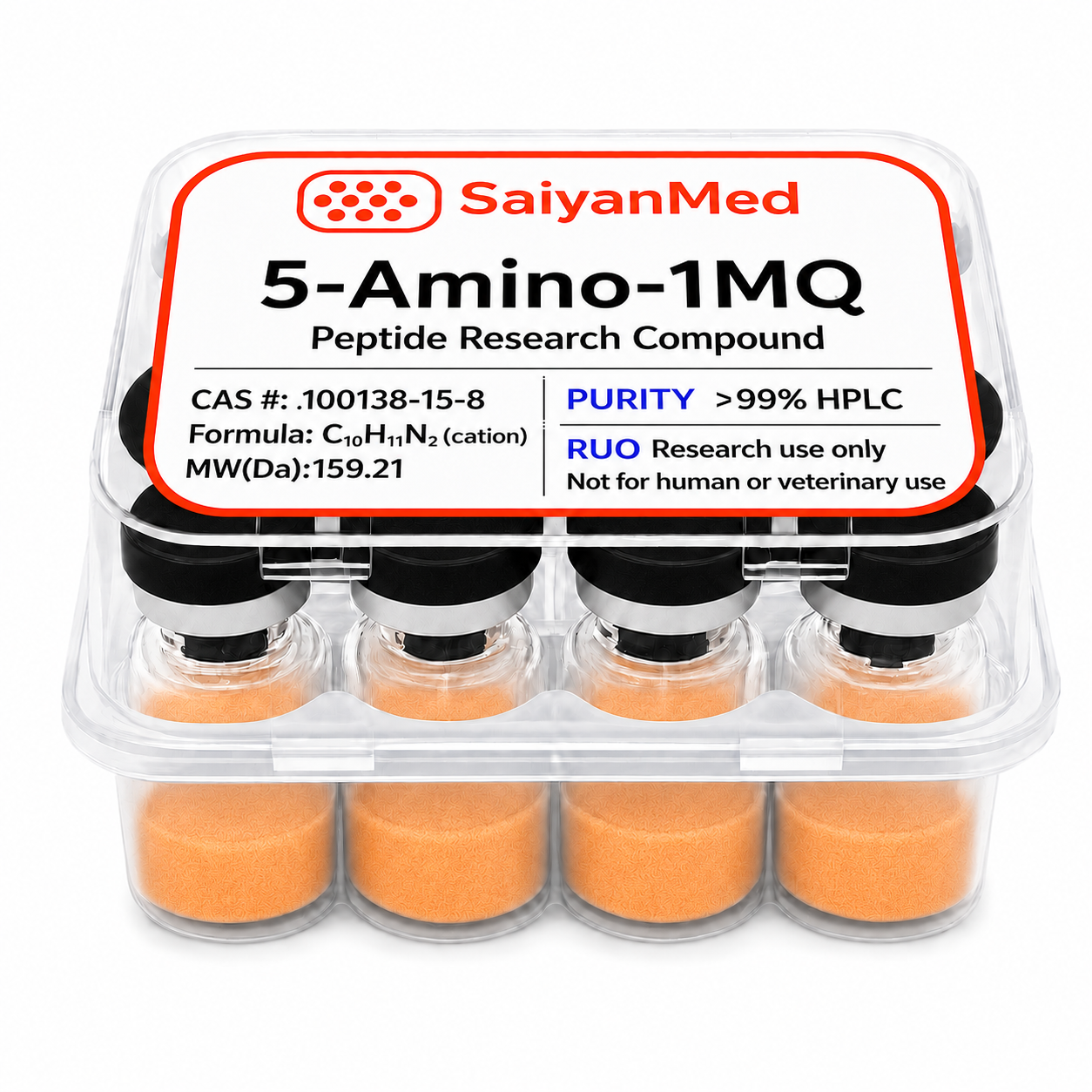
SaiyanMed Small-Molecule Research Series
5-Amino-1MQ
5-Amino-1-methylquinolinium · selective NNMT inhibitor · not a peptide
Research-grade 5-Amino-1MQ is a methylquinolinium small-molecule inhibitor of
nicotinamide N-methyltransferase (NNMT). It is supplied for qualified laboratory study of
NNMT enzymology, 1-methylnicotinamide formation, NAD+-salvage-related pathways,
S-adenosylmethionine balance, adipocyte models, and other preclinical metabolic systems.
This compound contains no amino-acid sequence and no peptide bonds. The supplied salt form,
molecular weight basis, purity, identity, and fill amount should be confirmed from the
lot-specific label and COA. For research use only — not for human or veterinary use.
Small Molecule
NNMT Inhibitor
Not a Peptide
HPLC & MS Documentation
Lot-Specific COA
5A1MQ
Reference Chemical Identity
5-Amino-1-methylquinolinium iodide
Iodide Salt Formula
C10H11IN2
Iodide Salt MW
286.11 g/mol
CAS
42464-96-0
Research Target
NNMT
Reference values above assume the iodide salt. Confirm the actual supplied form from the batch COA.
Correct Classification
5-Amino-1MQ is a small organic molecule, not a peptide
Although 5-Amino-1MQ is sometimes sold by suppliers that also list research peptides, its
chemistry is fundamentally different. It is a quaternary methylquinolinium compound with no
amino-acid chain, peptide bonds, sequence, disulfide bridges, or peptide molecular-weight profile.
Correct description
Small-molecule NNMT inhibitor
Methylquinolinium research compound supplied in a defined salt form.
≠
Do not describe it as
Peptide or amino-acid sequence
No peptide sequence or peptide-class pharmacology applies.
Research Background
What is 5-Amino-1MQ?
5-Amino-1MQ is the commonly used abbreviation for
5-amino-1-methylquinolinium. It was characterized as a selective,
membrane-permeable small-molecule inhibitor of nicotinamide N-methyltransferase in
biochemical, adipocyte, and mouse research.
NNMT catalyzes transfer of a methyl group from
S-adenosyl-L-methionine (SAM) to nicotinamide, producing
1-methylnicotinamide (1-MNA) and S-adenosyl-L-homocysteine. Because
nicotinamide is also used in the NAD+ salvage pathway, NNMT activity can
intersect with both nicotinamide availability and cellular methyl-donor balance.
In the cited preclinical work, 5-Amino-1MQ was examined for effects on intracellular
1-MNA, NAD+, SAM-related measures, adipocyte differentiation, lipid-related
endpoints, and diet-induced-obesity mouse models. These findings are preclinical and must
not be presented as evidence of human fat loss, metabolic improvement, anti-aging effects,
or clinical NAD+ enhancement.
Assay-Dependent Potency
IC50 values require test conditions
A value of approximately 1.2 μM is commonly reported for NNMT inhibition
under a specified in-vitro enzyme assay using defined substrate and SAM concentrations.
This is an assay-specific reference value, not a universal potency number for every enzyme
preparation, cell type, matrix, salt form, or finished vial.
Good reporting practice
Record enzyme source, substrate concentrations, SAM concentration, buffer, temperature,
readout method, and salt-equivalent concentration whenever potency is compared.
⚙️ NNMT Pathway Research Context
Nicotinamide + SAM
NNMT substrates
→
NNMT
Methyl-transfer enzyme targeted by 5-Amino-1MQ
→
1-MNA + SAH
Reaction products
Research interpretation:
NNMT inhibition is studied for how reduced nicotinamide methylation may alter 1-MNA
formation, nicotinamide partitioning, NAD+-salvage-related measurements, and
cellular methyl-economy markers. The direction and magnitude depend on the model and assay.
🔬 Research Applications
01
NNMT Enzymology
Enzyme-inhibition, substrate-site interaction, selectivity, and assay-development research.
02
1-MNA Formation
Cellular and biochemical measurement of nicotinamide methylation and 1-MNA production.
03
NAD+-Related Models
Preclinical analysis of nicotinamide partitioning and NAD+-salvage-related endpoints.
04
SAM / Methyl Economy
SAM, SAH, methyl-donor balance, and metabolic–epigenetic pathway research models.
05
Adipocyte Models
Adipocyte differentiation, intracellular metabolite, and lipid-related preclinical assays.
06
Rodent Metabolic Models
Pharmacokinetic, tissue-distribution, glucose-related, liver, muscle, and adipose endpoints in animal research.
📊 Quick Specifications
Product name: 5-Amino-1MQ
Chemical name: 5-amino-1-methylquinolinium
Compound class: Small-molecule methylquinolinium NNMT inhibitor
Peptide status: Not a peptide; no amino-acid sequence
Reference salt: Iodide salt
CAS for iodide salt: 42464-96-0
PubChem CID for iodide record: 66522933
PubChem CID for cation: 950107
Iodide-salt formula: C10H11IN2
Iodide-salt molecular weight: 286.11 g/mol
Cation formula: C10H11N2+
Cation molecular weight: 159.21 g/mol
Primary research target: Nicotinamide N-methyltransferase (NNMT)
Reference potency: approximately 1.2 μM IC50 under a specified in-vitro assay
Purity specification: ≥99% by HPLC, subject to lot-specific report
Identity specification: Mass-spectrometry confirmation, subject to lot-specific report
Product format: Lyophilized or dried research powder as stated on the lot label
Release: QC-released under SaiyanMed specifications
General sealed storage: −20°C, protected from light and moisture
Expiration: Use the date and stability statement on the lot-specific label or COA
🧂 Salt Form & Molecular-Weight Basis
Attribute
Iodide Salt Record
5-Amino-1MQ Cation
Name
5-Amino-1-methylquinolinium iodide
5-Amino-1-methylquinolinium
Formula
C10H11IN2
C10H11N2+
Molecular weight
286.11 g/mol
159.21 g/mol
Identifier
CAS 42464-96-0; PubChem CID 66522933
PubChem CID 950107; cation record
Use in calculations
Use when the vial contains the iodide salt and mass is stated as salt mass
Use only when concentration or content is explicitly reported as cation equivalent
SALT FORM MATTERS
Do not mix salt mass and cation-equivalent mass
A vial labeled by iodide-salt mass is not numerically equivalent to the same mass of free
cation. The product label and COA should state the supplied counterion, formula, molecular
weight used for identity confirmation, and whether the declared fill is salt mass or active-cation equivalent.
LOT VERIFICATION REQUIRED
Analytical Documentation
Confirm salt identity, purity, mass spectrum, and fill basis
Before laboratory use, match the vial lot with the analytical report. Confirm the chemical
name, counterion, molecular formula, molecular-weight basis, HPLC purity, mass-spectrometry
result, test date, sample amount, and finished-lot traceability. For a quaternary ammonium salt,
the observed mass-spectrometry ion may represent the organic cation rather than the intact salt;
the report should explain the assignment.
When a third-party lab report is supplied, validate its unique report identifier through the
official SaiyanMed Trust Center.
Do not display a storefront “verified” badge unless the currently sellable batch has a public,
matching report and the official verification link resolves correctly.
PRECLINICAL EVIDENCE
No human-benefit claims
The 5-Amino-1MQ studies cited on this page involve biochemical assays, cultured cells,
analytical methods, or rodents. This page does not identify a published human intervention
trial establishing safety, pharmacokinetics, dosing, weight-loss efficacy, metabolic benefit,
anti-aging activity, or NAD+ enhancement in people. Product-specific sterility,
endotoxin, bioavailability, and long-term stability also require separate evidence.
🧊 Storage & Laboratory Handling
Sealed research powder
Store at −20°C, tightly sealed and protected from light and moisture,
unless the lot-specific label, COA, or SDS provides a different validated condition.
Minimize unnecessary temperature cycling and document storage excursions.
Stock-solution preparation
Prepare solutions only under an approved laboratory protocol using a solvent confirmed
compatible with the supplied salt and intended assay. Record the salt form, solvent,
concentration basis, preparation date, operator, and storage condition. Do not assume that
a solvent recommendation for one supplier’s salt form applies to every lot.
Solution Stability
A universal 2–4 week refrigerated stability period is not asserted. Solution stability depends
on counterion, solvent, concentration, pH, container, light exposure, temperature, analytical
endpoint, and microbiological controls. Use a protocol-specific stability window and discard
solutions showing precipitation, discoloration, visible contamination, or undocumented excursions.
🚚 Fulfillment & Transit Notice
Fulfillment: Orders are routed from the nearest available logistics location.
Eligible domestic US orders may be fulfilled from a US warehouse; international orders may
ship from the China logistics warehouse. International delivery is generally estimated at
7–14 business days, subject to destination, carrier, and customs conditions.
Receipt and temperature: Inspect the container, seal, label, and package
promptly after delivery, then transfer the product to the stated storage condition. No blanket
claim is made that every ambient-temperature excursion is harmless; acceptability depends on
duration and available lot/form stability data.
Customs and import: Cross-border research-chemical shipments may be inspected,
delayed, assessed duties, or require consignee documentation. The purchaser is responsible for
destination-country import and possession requirements.
Damage, mismatch, or delay: Retain the shipping carton, product label, carrier
label, and clear photographs, then contact SaiyanMed with the order reference within the
applicable policy period.
⚠️
Research Use Only
This small-molecule research compound is supplied only for qualified laboratory use and is
not intended for human or veterinary administration.
Strict Use Limitation
Not a peptide, medicine, supplement, or consumer product
5-Amino-1MQ is an investigational NNMT inhibitor with a preclinical evidence base. It is
not represented as an FDA-approved drug, dietary supplement, weight-management product,
metabolic treatment, anti-aging product, or NAD+ therapy.
This page does not provide dosing, administration, injection, ingestion, self-experimentation,
clinical-treatment, or veterinary guidance.
✅ Purchaser Confirmation
✓ The purchaser is a qualified researcher or is working under qualified scientific supervision.
✓ The material will be used only in a legitimate and documented laboratory protocol.
✓ The purchaser will review the lot label, COA, SDS, salt form, and institutional requirements before use.
✓ The purchaser accepts responsibility for lawful import, possession, handling, storage, and disposal.
No efficacy or suitability warranty: Research outcomes depend on compound
form, counterion, experimental design, biological model, analytical method, solution
preparation, storage history, and other variables. Identity or purity documentation does not
guarantee a particular biological result.
🛡️ General Laboratory Controls
🚫 No Human or Veterinary Use
Do not ingest, administer, prescribe, dispense, or use for personal experimentation.
🥽 PPE & Containment
Apply appropriate gloves, eye protection, protective clothing, ventilation, and containment.
🧾 Salt & Lot Traceability
Record counterion, lot, report identifier, mass basis, solution preparation, and storage history.
🧪 Method Suitability
Validate assay selectivity, recovery, concentration range, controls, and matrix effects.
🗑 Controlled Disposal
Dispose of compound, solutions, and contaminated materials under applicable chemical-waste procedures.
⚖️ Legal Compliance
Confirm jurisdictional requirements before purchase, import, possession, transfer, or research use.
💬 Frequently Asked Questions
What is 5-Amino-1MQ?
+
5-Amino-1MQ is 5-amino-1-methylquinolinium, a small-molecule inhibitor of nicotinamide
N-methyltransferase supplied as a laboratory research compound. It is not intended for human or veterinary use.
Is 5-Amino-1MQ a peptide?
+
No. It is a methylquinolinium small molecule with no amino-acid sequence and no peptide bonds.
It should be described as a research compound or small-molecule NNMT inhibitor.
What does 5-Amino-1MQ inhibit?
+
It is used as an inhibitor of nicotinamide N-methyltransferase, the enzyme that transfers a methyl
group from SAM to nicotinamide to form 1-methylnicotinamide and SAH.
Why are two molecular weights listed?
+
The iodide salt has a molecular weight of approximately 286.11 g/mol, while the organic
5-amino-1-methylquinolinium cation is approximately 159.21 g/mol. Calculations must use the form
and mass basis stated on the lot label and COA.
Is the reported IC50 always 1.2 μM?
+
No. Approximately 1.2 μM is an in-vitro reference value from a defined NNMT assay. IC50 can change
with enzyme source, substrate and SAM concentrations, buffer, temperature, readout, and compound form.
Is there published human intervention evidence?
+
The product-specific studies cited on this page are biochemical, cell-based, analytical, or
animal studies. This page does not identify a published human intervention trial establishing
safety, dosing, pharmacokinetics, weight-loss efficacy, or metabolic benefit.
How should the COA be checked?
+
Match the vial lot to the report and confirm the counterion, formula, molecular-weight basis,
HPLC purity, mass-spectrometry assignment, test date, sample amount, and finished-lot traceability.
Validate any third-party report through the laboratory’s official verification portal.
How should sealed material be stored?
+
General SaiyanMed guidance is −20°C, sealed and protected from light and moisture, unless the
lot-specific label, COA, or SDS states otherwise. Solution stability must follow a
protocol-specific validated window.
Is this intended for human or veterinary use?
+
No. It is supplied strictly for qualified laboratory research and is not intended for ingestion,
administration, diagnosis, treatment, disease prevention, weight management, or personal use.
Where may orders be fulfilled from?
+
Eligible domestic US orders may be routed through US warehouse fulfillment, while international
orders may ship from the China logistics warehouse. Routing, delivery time, import requirements,
and customs processing depend on destination and carrier conditions.
📚 Scientific & Chemical References
These references support chemical identity, NNMT pharmacology, analytical methods, or preclinical
research findings. They do not establish a human-use indication or validate the exact SaiyanMed finished lot.
PubChem — NNMTi / 5-Amino-1-methylquinolinium iodide, CID 66522933:
Public chemical record listing CAS 42464-96-0, formula C10H11IN2, and molecular weight 286.11 g/mol.
View PubChem iodide-salt record ↗
PubChem — 5-Amino-1-methylquinolinium, CID 950107:
Public cation record listing formula C10H11N2+ and molecular weight 159.21 g/mol.
View PubChem cation record ↗
Neelakantan H, Vance V, Wetzel MD, et al. (2018):
Selective and membrane-permeable small molecule inhibitors of nicotinamide N-methyltransferase
reverse high fat diet-induced obesity in mice.
Biochemical Pharmacology, 147, 141–152. PMID 29155147; PMCID PMC5826726.
Primary biochemical, adipocyte, selectivity, permeability, and mouse proof-of-concept study.
View at PubMed ↗
Dimet-Wiley A, Neelakantan H, Al-Dokhi L, et al. (2022):
Reduced calorie diet combined with NNMT inhibition accelerates obesity reversal in diet-induced
obese mice. Scientific Reports, 12, 512. PMID 35013352.
Animal study of 5-amino-1-methylquinolinium combined with dietary intervention.
View at PubMed ↗
Babula JAJ, Neelakantan H, et al. (2024):
Nicotinamide N-methyltransferase inhibition mitigates obesity-induced insulin resistance and
hepatic steatosis. PMID 39161060.
Preclinical pharmacokinetic, tissue-distribution, glucose, adipose, and liver research in mice.
View at PubMed ↗
LC–MS/MS analytical-method study (2021):
Development and validation of an LC-MS/MS assay for 5-amino-1-methylquinolinium in rat plasma
and urine. PMID 34304009.
Supports analytical quantification in preclinical biological matrices.
View at PubMed ↗
Sigma-Aldrich — 5-Amino-1-methylquinolinium iodide, SML2832:
Commercial reference listing the iodide salt, powder form, HPLC assay, and an approximately
1.2 μM NNMT IC50 under stated enzyme-assay conditions. Included as a reagent specification
reference, not as clinical evidence.
View reagent record ↗
Reviews
There are no reviews yet.