Description
SaiyanMed Research Material
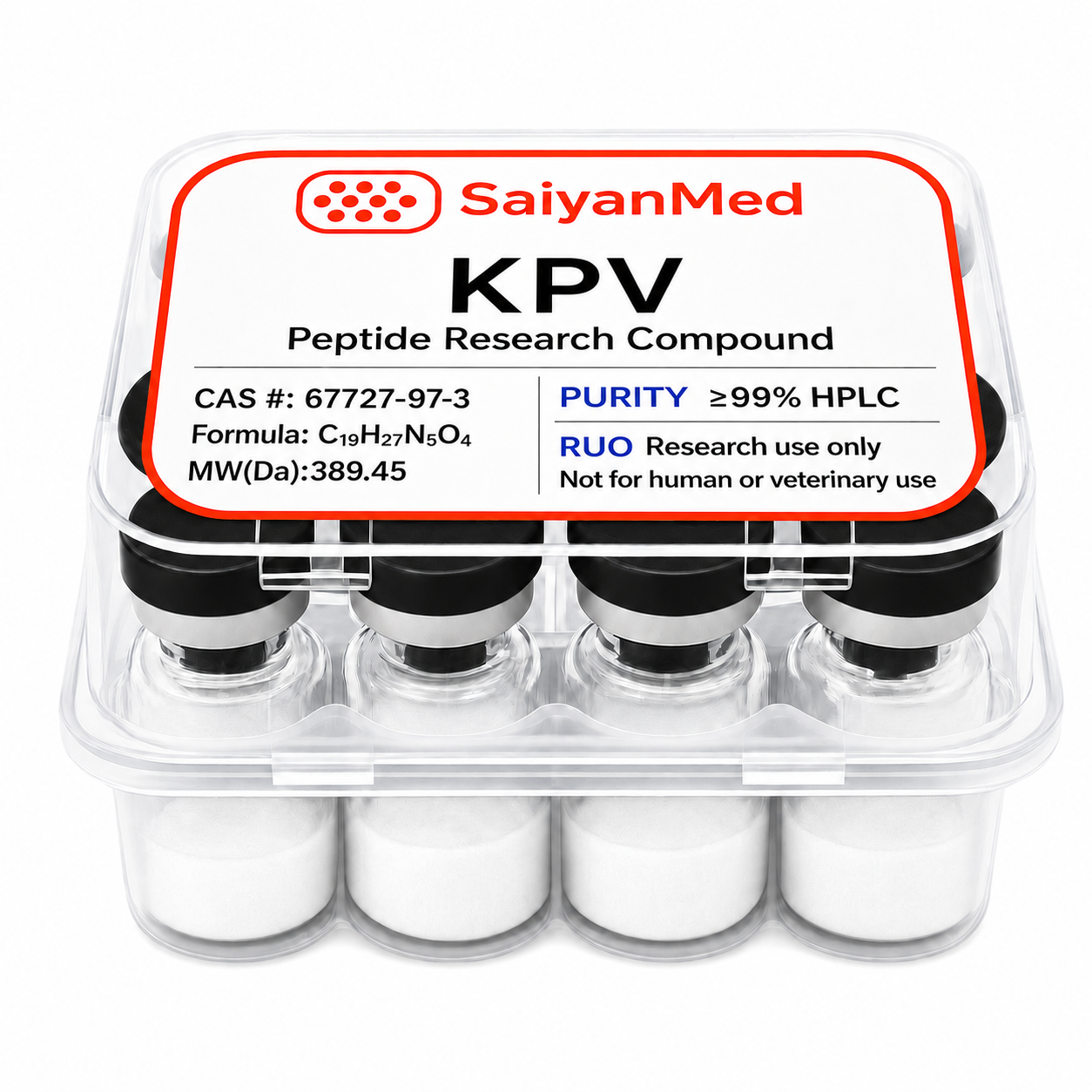
KPV
PepT1-dependent uptake · Inflammatory signaling assays
KPV is a compact Lys-Pro-Val tripeptide investigated at the intersection of peptide transport and intestinal inflammatory signaling. Research focuses on PepT1-mediated cellular uptake, NF-kappaB and MAP kinase pathways, and epithelial–immune interactions in cell cultures and mouse models of colitis.
Inflammatory signaling assays
Experimental colitis models
Laboratory material
Research use only
RESEARCH CONTEXT
PepT1-dependent uptake
Cell and mouse findings do not establish treatment of human inflammatory bowel disease or cancer. KPV is distinct from full-length alpha-MSH, whose biological activity and receptor profile do not establish those of this tripeptide.
Batch-specific documentation
RUO
Research Context
PepT1-dependent uptake
Uptake experiments in intestinal epithelial and Jurkat cell models examined whether PepT1 transports KPV and mediates its cellular activity.
Inflammatory signaling assays
Experimental colitis models
What is KPV?
KPV is the tripeptide Lys-Pro-Val, corresponding to the C-terminal three residues of alpha-melanocyte-stimulating hormone. KPV is a compact Lys-Pro-Val tripeptide investigated at the intersection of peptide transport and intestinal inflammatory signaling. Research focuses on PepT1-mediated cellular uptake, NF-kappaB and MAP kinase pathways, and epithelial–immune interactions in cell cultures and mouse models of colitis.
An original study measured NF-kappaB reporter activity, MAP kinase signaling and proinflammatory cytokine secretion in stimulated cell cultures. DSS- and TNBS-induced mouse colitis studies evaluated histology and cytokine mRNA as preclinical endpoints. A separate AOM/DSS mouse study compared PepT1-overexpressing and PepT1-knockout animals to investigate transporter dependence of KPV-associated tumor and inflammatory endpoints.
Cell and mouse findings do not establish treatment of human inflammatory bowel disease or cancer. KPV is distinct from full-length alpha-MSH, whose biological activity and receptor profile do not establish those of this tripeptide.
🧪 Research Applications
①
PepT1-dependent uptake
Uptake experiments in intestinal epithelial and Jurkat cell models examined whether PepT1 transports KPV and mediates its cellular activity.
②
Inflammatory signaling assays
An original study measured NF-kappaB reporter activity, MAP kinase signaling and proinflammatory cytokine secretion in stimulated cell cultures.
③
Experimental colitis models
DSS- and TNBS-induced mouse colitis studies evaluated histology and cytokine mRNA as preclinical endpoints.
④
Colitis-associated tumor biology
A separate AOM/DSS mouse study compared PepT1-overexpressing and PepT1-knockout animals to investigate transporter dependence of KPV-associated tumor and inflammatory endpoints.
⑤
Analytical Characterization
Assess material identity, composition, and method suitability using documentation for the exact sample; published research does not certify the commercial lot.
⑥
Study Interpretation
Interpret experimental results within the tested model and endpoint. Constituent or reference-compound findings do not establish clinical effects of this material.
📊 Quick Specs
Quality Documentation
Certificate of Analysis (COA)
A Certificate of Analysis records the identity checks, analytical methods and results reported for a specific sample or batch. Explore published quality reports in the SaiyanMed Trust Center.
For product or batch documentation enquiries, contact SaiyanMed with the product name and lot number, where available.
📦 Storage & Handling
Reference handling recommendation — only if supplied as a lyophilizate
For lyophilized reference peptides, Bachem recommends a tightly closed container below −15°C, with lower temperatures preferred for longer storage. Let the sealed vial reach ambient temperature in a desiccator before opening to limit moisture uptake.
Reference handling recommendation — peptide solution
For peptide solutions, select a suitable buffer, divide into single-use aliquots and keep frozen below −15°C following the cited general peptide guide. Avoid prolonged solution storage and repeated freeze–thaw cycles; set the stability window for the actual sample and experiment.
🚚 Fulfillment & Transit Notice
Global logistics: Orders ship from the nearest available warehouse. US-based warehouse fulfillment is available for domestic US orders; international orders ship from our Asian logistics hub with an estimated 7–14 day global delivery window. Delivery estimates may vary with destination, carrier and customs processing.
Temperature in transit: Follow the storage and handling guidance for the product’s supplied form upon arrival. Dry peptides, prepared solutions and liquid formulations have different handling requirements; contact us with the product and order reference if you have concerns about transit conditions.
Customs & duties: Cross-border research-chemical shipments may occasionally be subject to customs inspection or delay. Import duties and local customs requirements remain the responsibility of the consignee. A customs hold does not by itself indicate a product issue.
Delays or holds: If a shipment is delayed beyond the estimated window or held in customs, contact us with your order reference. We will assist with tracking and, where applicable, arrange a reshipment in line with our shipping policy.
Damaged or incorrect items: Please inspect your order on arrival. If a vial is damaged or an item is incorrect, contact us within the period stated in our shipping policy, with photos, for prompt resolution.
⚠️
Research Use Only
This material is supplied only for qualified laboratory research and is not intended for human or veterinary use.
Research Use Only
Not for Human Consumption
This listing is for laboratory research only. It is not intended for diagnostic, therapeutic, medical, disease-prevention, consumer-health, or personal use.
It is not for human consumption, medical treatment, diagnosis, disease prevention, or veterinary use.
✅ Buyer Confirmation
✓ You are a qualified researcher or acting under one’s supervision.
✓ The material will be used only for legitimate laboratory research.
✓ No human-use approval, efficacy, or safety claim is made for this listing.
✓ You are responsible for applicable laws and institutional procedures.
No Warranty: Product-specific identity, quality, safety, and suitability are not independently established by this page. Research outcomes and interpretations depend on the material and study design.
🛡️ General Safety & Handling
🚫 Not for Human Use
For qualified laboratory research only; not for human or veterinary administration.
🥽 PPE Required
Use appropriate personal protective equipment and institutional laboratory controls.
🌡 Follow Lot Documentation
Product-specific storage and stability details are not supplied on this listing.
🗑 Proper Disposal
Follow institutional biosafety and waste-disposal procedures.
🧾 Verify the Lot
Do not assume product identity or purity without batch-matched documentation.
⚖ Legal Compliance
Researchers are responsible for lawful possession and use in their jurisdiction.
💬 Frequently Asked Questions
Can I order KPV instead of full-length alpha-MSH for the same experiment?+
KPV is only a three-residue fragment of alpha-MSH, not a smaller pack of the full peptide. Choose the material specified in your experiment, because the fragment does not simply reproduce the full peptide’s receptor activity.
Are KPV, KPV acetate and amidated KPV the same material?+
No—acetate describes a salt form, while amidation changes the peptide’s end group. Match both the terminal form and the stated peptide-content basis rather than comparing products by mg alone.
Should I choose KPV alone or a blend that includes KPV?+
Choose KPV alone if you need to measure its contribution separately or vary its amount independently. A multipeptide blend introduces other components and a fixed composition, so its total weight is not its KPV content.
Does the larger KPV vial option contain a different concentration?+
The mg choice states an amount of material per vial, not a solution concentration. Select the amount that fits your laboratory workload rather than treating the larger option as a different chemical form or quality grade.
📚 References
PepT1-mediated tripeptide KPV uptake reduces intestinal inflammation (2008; PMID 18061177)
Read source ↗
Reference context only; not a certificate or batch test for this product.
Critical role of PepT1 in promoting colitis-associated cancer and therapeutic benefits of the anti-inflammatory PepT1-mediated tripeptide KPV in a murine model (2016; PMID 27458604)
Read source ↗
Reference context only; not a certificate or batch test for this product.
Specification & handling references
Technical reference ↗
Technical reference ↗
Technical reference ↗
Reviews
There are no reviews yet.