Description
/* Reset & Base */
* {
box-sizing: border-box;
margin: 0;
padding: 0;
}
body {
font-family: ‘Inter’, -apple-system, BlinkMacSystemFont, ‘Segoe UI’, Roboto, Helvetica, Arial, sans-serif;
background: #fff;
color: #1e1e1e;
line-height: 1.6;
}
/* Utilities */
.sm-container {
max-width: 1300px;
margin: 0 auto;
padding: 20px 32px 60px;
width: 100%;
}
.sm-grid-2 {
display: grid;
grid-template-columns: 1fr 1fr;
gap: 40px;
}
.sm-grid-3 {
display: grid;
grid-template-columns: repeat(3, 1fr);
gap: 24px;
}
/* Tabs */
.sm-tab-input {
display: none;
}
.sm-panel {
display: none;
}
#sm-tab-product:checked ~ .sm-tab-nav label[for=”sm-tab-product”],
#sm-tab-disclaimer:checked ~ .sm-tab-nav label[for=”sm-tab-disclaimer”] {
background: #F27444;
color: #fff;
border-color: #F27444;
box-shadow: 0 8px 20px rgba(242, 116, 68, 0.25);
}
#sm-tab-product:checked ~ .sm-product-panel {
display: block;
}
#sm-tab-disclaimer:checked ~ .sm-disclaimer-panel {
display: block;
}
/* FAQ */
.sm-faq summary::-webkit-details-marker {
display: none;
}
.sm-faq[open] .sm-plus {
transform: rotate(45deg);
}
/* Chips */
.sm-chip {
display: inline-block;
padding: 8px 16px;
border-radius: 999px;
background: #fff4ef;
border: 1px solid #ffd9cb;
color: #F27444;
font-weight: 600;
font-size: 0.9rem;
margin: 4px 6px 4px 0;
letter-spacing: 0.02em;
}
/* Cards & Hover */
.sm-card {
background: #fff;
border: 1px solid #f0e8e4;
border-radius: 28px;
padding: 28px;
transition: all 0.2s ease-in-out;
}
.sm-card:hover {
transform: translateY(-4px);
box-shadow: 0 20px 40px -12px rgba(0, 0, 0, 0.08);
border-color: #F27444;
}
.sm-card-glow {
background: linear-gradient(135deg, #fff 0%, #fff8f5 100%);
border: 1px solid #ffe1d6;
}
/* Specs Zebra */
.sm-spec-grid {
display: grid;
grid-template-columns: 1fr 1fr;
}
.sm-spec-item {
padding: 16px 24px;
border-bottom: 1px solid #f0e8e4;
background: #fff;
}
.sm-spec-item:nth-child(odd) {
background: #fcfaf9;
}
/* Responsive */
@media (max-width: 768px) {
.sm-container {
padding: 20px 16px 40px;
}
.sm-grid-2,
.sm-grid-3 {
grid-template-columns: 1fr !important;
gap: 20px;
}
.sm-spec-grid {
grid-template-columns: 1fr;
}
.sm-tab {
width: 100% !important;
text-align: center !important;
}
.sm-hero-title {
font-size: 32px !important;
}
h2 {
font-size: 24px !important;
}
}
/* Misc */
.sm-tab {
font-size: 1rem;
padding: 12px 32px;
border-radius: 999px;
background: #fff;
border: 1px solid #e0d6d0;
color: #1e1e1e;
cursor: pointer;
font-weight: 600;
transition: all 0.2s;
user-select: none;
}
.sm-tab:hover {
background: #fff4ef;
border-color: #F27444;
}
.sm-hero-bg {
background: radial-gradient(ellipse at 70% 20%, rgba(242, 116, 68, 0.05) 0%, rgba(255, 255, 255, 0) 70%);
}
.sm-note {
padding: 16px 18px;
border-radius: 16px;
background: #fffaf7;
border: 1px solid #ffe1d6;
color: #555;
font-size: 0.93rem;
line-height: 1.7;
}
/* Reference list item hover */
.ref-item {
padding: 16px 20px;
background: #fff;
border-radius: 16px;
border: 1px solid #f0e8e4;
transition: all 0.2s ease-in-out;
}
.ref-item:hover {
border-color: #F27444;
box-shadow: 0 4px 12px rgba(242, 116, 68, 0.08);
}
.ref-item a {
color: #F27444;
font-weight: 700;
text-decoration: none;
}
.ref-item a:hover {
text-decoration: underline;
}
SaiyanMed · Endocrine Research
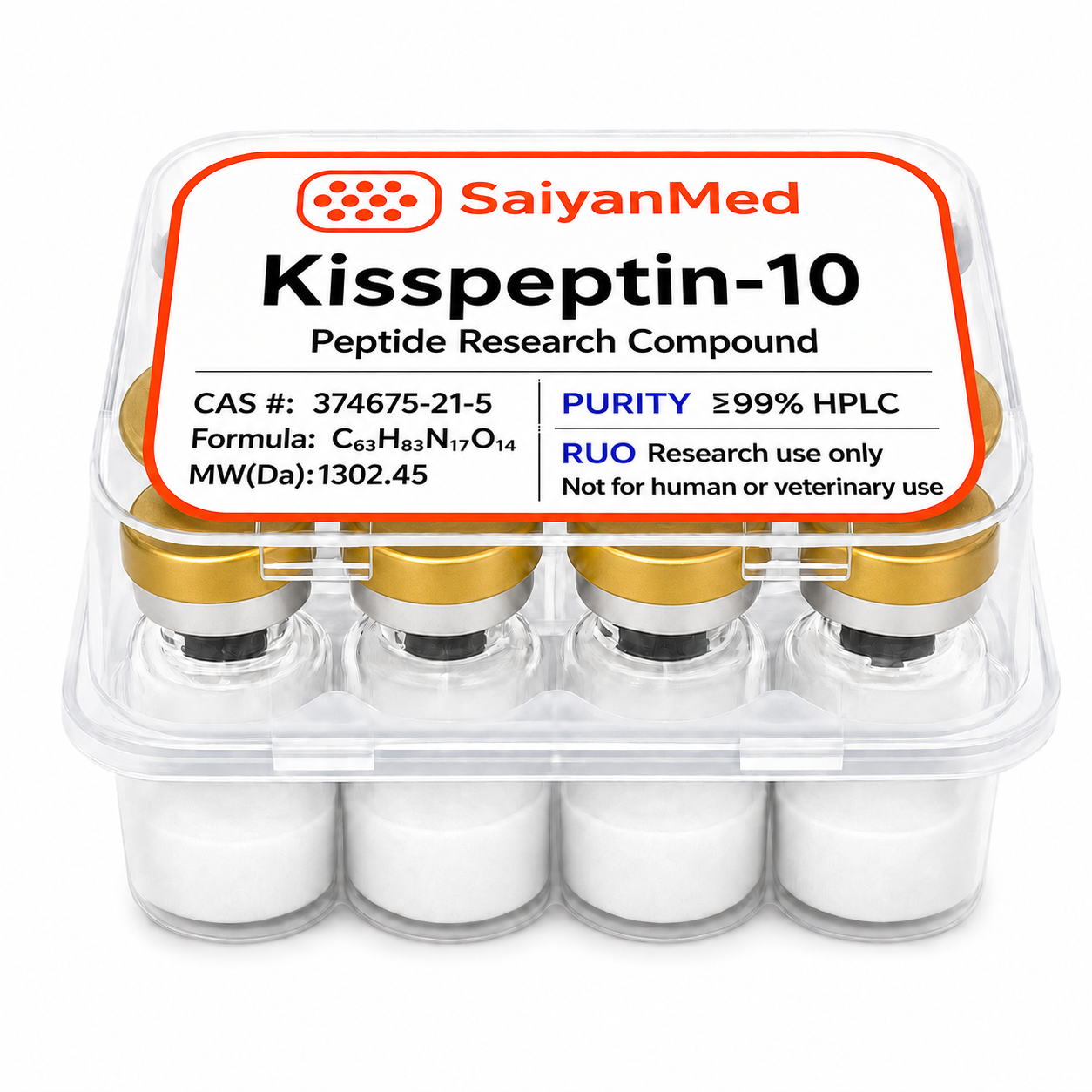
Kisspeptin-10 (KP-10)
C-terminal decapeptide KISS1R / GPR54 agonist for GnRH and HPG-axis research · research grade
Research-grade Kisspeptin-10 (KP-10; human metastin 45-54) is the C-terminally amidated decapeptide derived from the KISS1 gene product and a potent agonist of the kisspeptin receptor, KISS1R / GPR54. It is supplied for laboratory investigation of receptor pharmacology, Gq/PLC/Ca2+ signalling, GnRH-linked neuroendocrine pathways, and HPG-axis research models. Each released vial is lyophilized and accompanied by batch documentation for HPLC purity and mass-spectrometric identity. For research use only — not for human or veterinary use.
≥99% HPLC
MS Confirmed
Batch-Specific COA
Lyophilized
Global Warehouse Fulfillment
KISSPEPTIN RECEPTOR AGONIST
KISS1R · GPR54
A compact 10-amino-acid research ligand for studying KISS1R activation and downstream Gq/11-coupled phospholipase-C and calcium-signalling pathways.
10 AA
CAS 374675-21-5
RF-NH₂ Motif
RUO
Research Context
A Minimal KISS1R Ligand
KP-10 contains the conserved C-terminal receptor-activating region shared by kisspeptin peptides. Its short sequence makes it useful for receptor assays, signalling experiments, structure-activity work, and controlled comparison with longer KISS1-derived peptides.
KISS1R Agonism
Gq / PLC Signalling
GnRH Research Models
What is Kisspeptin-10?
Kisspeptin-10 (KP-10; human metastin 45-54) is a C-terminally amidated peptide with the sequence Tyr-Asn-Trp-Asn-Ser-Phe-Gly-Leu-Arg-Phe-NH2. It represents the bioactive C-terminal region of human kisspeptin and carries the characteristic Arg-Phe-amide ending associated with RF-amide peptides.
KP-10 activates KISS1R, historically called GPR54. In receptor-expression and neuroendocrine research systems, KISS1R primarily couples to Gq/11, stimulating phospholipase C, phosphoinositide turnover, intracellular calcium mobilisation, and downstream kinase signalling. Kisspeptin-to-KISS1R signalling is an established upstream regulator of GnRH-neuron activity and is therefore widely used in HPG-axis and reproductive-endocrinology research.
KISS1 was first characterized in metastasis-suppression research. For that reason, KISS1-derived peptides and KISS1R remain relevant to cell-migration, invasion, and receptor-signalling models in oncology. These statements describe experimental research contexts only and do not imply a clinical or consumer use.
🧪 Research Applications
①
KISS1R / GPR54 Pharmacology
Receptor activation, concentration-response, ligand-binding, internalisation, and desensitisation research models.
②
Gq / PLC / Ca²⁺ Signalling
Phosphoinositide turnover, intracellular calcium mobilisation, PKC, ERK, and related downstream signalling assays.
③
GnRH / HPG-Axis Models
Experimental study of kisspeptin-linked GnRH-neuron activation and hypothalamic-pituitary-gonadal-axis regulation.
④
Pubertal-Onset Neuroendocrinology
Research into KISS1/KISS1R pathway development, neuroendocrine timing, and upstream control of gonadotropin signalling.
⑤
Cell Migration & Invasion
KISS1/KISS1R-related migration, invasion, cytoskeletal, and MAPK research in receptor-appropriate cellular models.
⑥
Peptide Structure-Activity
Comparative studies of KP-10 and longer kisspeptin fragments, terminal amidation, sequence substitutions, and RF-amide motifs.
📊 Quick Specs
Form: Lyophilized powder (white to off-white)
Purity: ≥99% by HPLC — batch release specification
Identity: Molecular mass confirmed by MS — batch release specification
CAS Number: 374675-21-5 (human Kisspeptin-10)
PubChem CID: 25240297
Also Known As: KP-10; human metastin 45-54; Kisspeptin-10 (human)
Sequence: Tyr-Asn-Trp-Asn-Ser-Phe-Gly-Leu-Arg-Phe-NH₂
One-Letter Sequence: YNWNSFGLRF-NH₂ (10 amino acids)
Molecular Formula: C63H83N17O14
Molecular Weight: 1302.4 g/mol (PubChem computed)
Receptor Target: KISS1R / GPR54
Primary Signalling: Gq/11 → PLC → phosphoinositide turnover / Ca²⁺ mobilisation
Peptide Class: C-terminally amidated KISS1-derived decapeptide
Motif: C-terminal Arg-Phe-NH₂
COA: Batch-specific third-party report with online authenticity check where published
Manufacture: Lyophilized & QC-released in-house
Preferred Storage: −20°C sealed; protect from light and moisture
Reconstituted Handling: 2–8°C; follow study-specific stability controls
Stated Shelf Life: 24 months unopened under specified storage conditions
Intended Use: Laboratory research only; not for human or veterinary use
Documentation note: Chemical identity values above are referenced to the human KP-10 structure listed by PubChem. Purity, fill quantity, shelf life, and third-party testing are batch- or supplier-specific claims and should match the current lot COA and internal stability records.
BATCH TRACEABLE
Certificate of Analysis
Lot-Specific Analytical Documentation
SaiyanMed release documentation records the tested lot, analytical identity, HPLC purity result, and applicable third-party report details. When a third-party lab report is issued for a batch, its authenticity can be checked through the laboratory’s official verification page using the report task number and unique key.
Before beginning a study, confirm that the product label, lot number, reported test item, peptide identity, and COA all correspond to the same batch. A general example report must not be treated as batch-specific evidence.
📦 Storage & Laboratory Handling
🧊 Storage
Keep sealed lyophilized vials at −20°C, protected from light, moisture, and unnecessary temperature cycling. After reconstitution, maintain at 2–8°C and use within the stability window established by the laboratory protocol; SaiyanMed’s general handling window is 2–4 weeks unless the lot documentation states otherwise. Avoid repeated freeze-thaw cycles. Do not use a solution that is visibly cloudy, discoloured, or particulate.
💧 Reconstitution
Using aseptic laboratory technique, introduce 1–2 mL of a protocol-compatible sterile diluent slowly along the vial wall. Do not shake or vortex. Swirl gently until dissolved, then prepare working concentrations according to the validated assay method. Record solvent, concentration, date, operator, and storage conditions as part of the study file.
Reconstitution volume and post-reconstitution hold time are laboratory-protocol variables, not universal chemical constants. Critical or regulated studies should establish their own stability and recovery data.
🚚 Fulfillment & Transit Information
Dispatch route: Orders are assigned to the closest available fulfillment location. Eligible US orders are fulfilled through the US warehouse; other destinations are generally supplied through SaiyanMed’s China-based international logistics center. Tracking is provided after carrier acceptance.
Transit window: International delivery is commonly estimated at 7–14 business days, excluding customs review, remote-area handoff, severe weather, and carrier disruption. Delivery estimates are not guarantees.
Temperature exposure: Sealed lyophilized peptide vials are shipped without reconstitution and are less vulnerable to short transport excursions than prepared solutions. Transfer the parcel to the specified storage condition promptly after delivery. Batch-specific stability data take precedence over general shipping guidance.
Customs: The consignee is responsible for checking import eligibility, permits, taxes, duties, and institutional receiving rules. Customs inspection can extend delivery time and does not by itself indicate damage or loss of identity.
Arrival inspection: Check the package, vial, label, lot number, and accompanying documents immediately. Report damage, leakage, missing items, or label discrepancies within the period stated in the current shipping policy and include clear photographs.
⚠️
Research Use Only
Kisspeptin-10 is supplied to qualified laboratories as an analytical and experimental research material. It is not a medicine, supplement, food, cosmetic ingredient, or veterinary product.
Scope of Supply
No Human or Veterinary Administration
SaiyanMed supplies this material solely for legitimate in vitro or institutionally authorized in vivo research. It is not offered for self-experimentation, compounding, diagnosis, treatment, disease prevention, fertility intervention, hormone modification, or any consumer-health purpose.
Mechanistic descriptions of KISS1R, GnRH, gonadotropin, puberty, reproductive physiology, or cell migration are scientific background for research-model selection. They are not efficacy, safety, or therapeutic claims.
✅ Purchaser Representations
✓ The purchaser is a qualified researcher, laboratory, institution, or authorized procurement representative.
✓ The material will be used only within an appropriate research protocol and facility.
✓ The purchaser will not administer, dispense, prescribe, resell, or promote the material for human or animal use.
✓ The purchaser accepts responsibility for import rules, institutional approvals, handling controls, records, and disposal.
Research-material limitation: Unless expressly stated in a signed agreement, the material is supplied “as is” for research use. SaiyanMed does not warrant that a particular assay, model, endpoint, or interpretation will produce a specific result. The laboratory is responsible for method suitability, controls, validation, and data interpretation.
🛡️ Laboratory Safety & Control
🚫 Restricted Use
Keep the material outside clinical, consumer, household, and veterinary channels.
🥽 Risk Assessment
Use the PPE, engineering controls, and exposure precautions required by your institutional risk assessment.
🧾 Lot Control
Match the vial, lot number, COA, test identity, and chain-of-custody record before opening.
🌡 Cold Storage
Log receipt and storage temperatures; minimize light exposure and temperature cycling.
🧪 Assay Controls
Use suitable blanks, positive controls, solvent controls, and concentration-verification procedures.
🗑 Disposal
Dispose of peptide material, solutions, vials, and contaminated consumables under applicable institutional procedures.
💬 Frequently Asked Questions
What is Kisspeptin-10 (KP-10)?+
Kisspeptin-10 is the C-terminally amidated 10-amino-acid region of human kisspeptin, also called human metastin 45-54. It is used as a KISS1R / GPR54 agonist reference material in receptor-signalling and neuroendocrine research models.
What is the sequence of human KP-10?+
The sequence is Tyr-Asn-Trp-Asn-Ser-Phe-Gly-Leu-Arg-Phe-NH₂, written in one-letter code as YNWNSFGLRF-NH₂. The terminal phenylalanine is amidated.
Which receptor does KP-10 activate?+
KP-10 activates KISS1R, the receptor historically known as GPR54. In common experimental systems, KISS1R primarily couples to Gq/11 and activates phospholipase-C-dependent phosphoinositide and intracellular-calcium signalling.
Why is KP-10 used in GnRH and HPG-axis research?+
KISS1/KISS1R signalling is an established upstream regulator of GnRH-neuron activity. KP-10 therefore provides a defined receptor agonist for laboratory models examining GnRH-linked signalling and hypothalamic-pituitary-gonadal-axis regulation. This is research context, not a human-use claim.
How is batch quality documented?+
SaiyanMed’s stated release specification is ≥99% purity by HPLC with peptide identity confirmed by mass spectrometry. Review the lot-specific COA rather than relying on a general product-page claim. When a third-party lab report is provided, verify it using the report task number and unique key on the laboratory’s official verification page.
How should Kisspeptin-10 be stored?+
Store sealed lyophilized vials at −20°C, protected from light and moisture. After reconstitution, keep at 2–8°C and follow the stability window established for the study or stated in the lot documentation. Avoid repeated freeze-thaw cycles.
Is this product intended for human use?+
No. This product is a laboratory research material only. It is not intended for human consumption, self-administration, diagnosis, treatment, disease prevention, compounding, or veterinary use.
📚 Scientific & Identity References
PubChem:
Kisspeptin-10, CID 25240297 — CAS number, molecular formula, molecular weight, synonyms, and chemical structure record.
View PubChem record ↗
UniProtKB — KISS1:
Human KISS1 precursor and processed kisspeptin annotations (Q15726).
View KISS1 entry ↗
UniProtKB — KISS1R:
Human kisspeptin receptor function and GnRH/HPG-axis pathway context (Q969F8).
View KISS1R entry ↗
Kotani M, et al. (2001):
The metastasis suppressor gene KiSS-1 encodes kisspeptins, the natural ligands of the orphan G-protein-coupled receptor GPR54.
Journal of Biological Chemistry 276:34631–34636. PMID 11457843.
View at PubMed ↗
Ohtaki T, et al. (2001):
Metastasis suppressor gene KiSS-1 encodes peptide ligand of a G-protein-coupled receptor.
Nature 411:613–617. PMID 11385580.
View at PubMed ↗
Messager S, et al. (2005):
Kisspeptin directly stimulates gonadotropin-releasing hormone release via G protein-coupled receptor 54.
Proceedings of the National Academy of Sciences 102:1761–1766. PMID 15665093.
View at PubMed ↗
de Roux N, et al. (2003):
Hypogonadotropic hypogonadism due to loss of function of the KiSS1-derived peptide receptor GPR54.
Proceedings of the National Academy of Sciences 100:10972–10976. PMID 12944565.
View at PubMed ↗
Reviews
There are no reviews yet.