Description
/* Reset & Base */
* {
box-sizing: border-box;
margin: 0;
padding: 0;
}
body {
font-family: ‘Inter’, -apple-system, BlinkMacSystemFont, ‘Segoe UI’, Roboto, Helvetica, Arial, sans-serif;
background: #fff;
color: #1e1e1e;
line-height: 1.6;
}
/* Utilities */
.sm-container {
max-width: 1300px;
margin: 0 auto;
padding: 20px 32px 60px;
width: 100%;
}
.sm-flex {
display: flex;
flex-wrap: wrap;
}
.sm-grid-2 {
display: grid;
grid-template-columns: 1fr 1fr;
gap: 40px;
}
.sm-grid-3 {
display: grid;
grid-template-columns: repeat(3, 1fr);
gap: 24px;
}
.sm-grid-4 {
display: grid;
grid-template-columns: repeat(4, 1fr);
gap: 20px;
}
/* Tabs */
.sm-tab-input {
display: none;
}
.sm-panel {
display: none;
}
#sm-tab-product:checked~.sm-tab-nav label[for=”sm-tab-product”],
#sm-tab-disclaimer:checked~.sm-tab-nav label[for=”sm-tab-disclaimer”] {
background: #F27444;
color: #fff;
border-color: #F27444;
box-shadow: 0 8px 20px rgba(242, 116, 68, 0.25);
}
#sm-tab-product:checked~.sm-product-panel {
display: block;
}
#sm-tab-disclaimer:checked~.sm-disclaimer-panel {
display: block;
}
/* FAQ */
.sm-faq summary::-webkit-details-marker {
display: none;
}
.sm-faq[open] .sm-plus {
transform: rotate(45deg);
}
/* Chips */
.sm-chip {
display: inline-block;
padding: 8px 16px;
border-radius: 999px;
background: #fff4ef;
border: 1px solid #ffd9cb;
color: #F27444;
font-weight: 600;
font-size: 0.9rem;
margin: 4px 6px 4px 0;
letter-spacing: 0.02em;
}
/* Cards & Hover */
.sm-card {
background: #fff;
border: 1px solid #f0e8e4;
border-radius: 28px;
padding: 28px;
transition: all 0.2s ease-in-out;
}
.sm-card:hover {
transform: translateY(-4px);
box-shadow: 0 20px 40px -12px rgba(0, 0, 0, 0.08);
border-color: #F27444;
}
.sm-card-glow {
background: linear-gradient(135deg, #fff 0%, #fff8f5 100%);
border: 1px solid #ffe1d6;
}
/* Specs Zebra */
.sm-spec-grid {
display: grid;
grid-template-columns: 1fr 1fr;
}
.sm-spec-item {
padding: 16px 24px;
border-bottom: 1px solid #f0e8e4;
background: #fff;
}
.sm-spec-item:nth-child(odd) {
background: #fcfaf9;
}
/* Responsive */
@media(max-width:768px) {
.sm-container {
padding: 20px 16px 40px;
}
.sm-grid-2,
.sm-grid-3,
.sm-grid-4 {
grid-template-columns: 1fr !important;
gap: 20px;
}
.sm-spec-grid {
grid-template-columns: 1fr;
}
.sm-tab {
width: 100% !important;
text-align: center !important;
}
.sm-hero-title {
font-size: 32px !important;
}
h2 {
font-size: 24px !important;
}
}
/* Misc */
.sm-tab {
font-size: 1rem;
padding: 12px 32px;
border-radius: 999px;
background: #fff;
border: 1px solid #e0d6d0;
color: #1e1e1e;
cursor: pointer;
font-weight: 600;
transition: all 0.2s;
user-select: none;
}
.sm-tab:hover {
background: #fff4ef;
border-color: #F27444;
}
.sm-hero-bg {
background: radial-gradient(ellipse at 70% 20%, rgba(242, 116, 68, 0.04) 0%, rgba(255, 255, 255, 0) 70%);
}
.sm-inline-link {
color: #F27444;
font-weight: 700;
text-decoration: underline;
text-underline-offset: 2px;
}
.sm-note {
color: #666;
font-size: 0.9rem;
line-height: 1.7;
}
/* Reference list item hover */
.ref-item {
padding: 16px 20px;
background: #fff;
border-radius: 16px;
border: 1px solid #f0e8e4;
transition: all 0.2s ease-in-out;
}
.ref-item:hover {
border-color: #F27444;
box-shadow: 0 4px 12px rgba(242, 116, 68, 0.08);
}
.ref-item a {
color: #F27444;
font-weight: 700;
text-decoration: none;
}
.ref-item a:hover {
text-decoration: underline;
}
SaiyanMed Research Grade
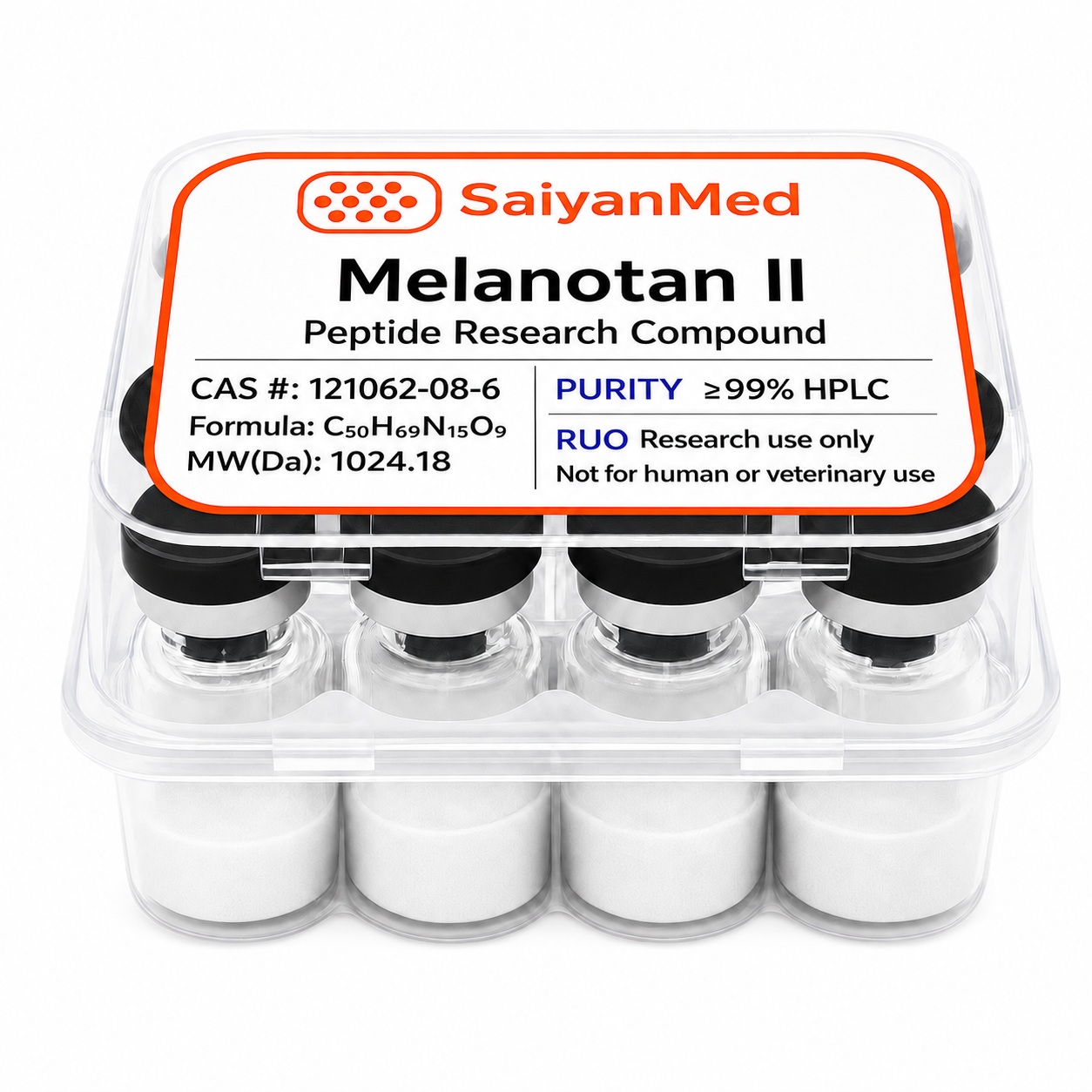
Melanotan Ⅱ
Cyclic lactam α-MSH analog · agonist at MC1R, MC3R, MC4R, and MC5R · research grade
Research-grade Melanotan Ⅱ (MT-II) is a conformationally constrained, cyclic seven-residue analog of α-melanocyte-stimulating hormone (α-MSH), supplied for laboratory study of melanocortin-receptor pharmacology, melanogenesis, and receptor-subtype signalling models. Each vial is lyophilized and supplied to a SaiyanMed specification of ≥99% HPLC purity with mass-spectrometry identity confirmation and a batch-specific, independently verifiable third-party lab report. For research use only — not for human or veterinary use.
≥99% HPLC Spec.
MS Confirmed
Third-Party Report
Lyophilized
Global Warehouse Fulfillment
CYCLIC α-MSH ANALOG · MELANOCORTIN AGONIST
MC1R · MC3R · MC4R · MC5R
Designed for research models comparing receptor-subtype binding and signalling across the melanocortin system. MT-II is chemically distinct from linear Melanotan Ⅰ and from the related C-terminal free-acid analog PT-141 (bremelanotide).
7 Residues
CAS 121062-08-6
RUO
Research Context
Broad Melanocortin Research Tool
Melanotan Ⅱ is positioned for mechanistic research into cyclic melanocortin-peptide pharmacology, receptor-subtype binding, second-messenger signalling, and structure–activity relationships. It is not offered for tanning, cosmetic, sexual-performance, weight-management, therapeutic, or personal use.
MC1/3/4/5R
Cyclic Lactam
SAR Research
What is Melanotan Ⅱ?
Melanotan Ⅱ (MT-II) is a synthetic cyclic heptapeptide analog built around the His–D-Phe–Arg–Trp melanocortin pharmacophore. Its sequence is commonly represented as Ac-Nle-cyclo[Asp-His-D-Phe-Arg-Trp-Lys]-NH2, with a side-chain lactam linkage between the Asp and Lys residues. The ring constrains peptide conformation and distinguishes MT-II from linear α-MSH analogs.
In a published human-receptor binding study, MT-II bound MC1R, MC3R, MC4R, and MC5R with reported Ki values of 0.67, 34, 6.6, and 46 nM, respectively. These values are assay-specific results from cells expressing recombinant human receptors; they should not be treated as universal constants across assay platforms.
These receptor subtypes support different experimental questions, including MC1R-associated melanocyte signalling and MC3R/MC4R-associated neuroendocrine and energy-homeostasis pathways. All such references describe laboratory or published pharmacology context, not consumer benefits or instructions for personal use.
Bremelanotide (PT-141) is a closely related cyclic analog with a free C-terminal carboxyl group, whereas MT-II terminates in a carboxamide. The two compounds are useful comparators but are chemically distinct; this page does not represent MT-II as bremelanotide or as an approved drug product.
Compared with linear, predominantly MC1R-binding Melanotan Ⅰ (afamelanotide), MT-II is cyclic and displays measurable affinity across MC1R, MC3R, MC4R, and MC5R in the cited receptor-binding system.
🧪 Research Applications
①
Melanocortin-Receptor Pharmacology
Comparative MC1R, MC3R, MC4R, and MC5R binding, activation, desensitization, and signalling models.
②
Melanogenesis Research
MC1R-associated melanocyte signalling and melanin-synthesis research models.
③
MC3R / MC4R Pathway Research
Neuroendocrine, feeding-behaviour, and energy-homeostasis models described in preclinical literature.
④
Central Melanocortin Signalling
Laboratory investigation of MC3R/MC4R-associated neuronal pathways and second-messenger responses.
⑤
SAR / Reference Agonist Studies
Structure–activity research involving cyclic lactam melanocortin peptides and receptor-subtype selectivity.
⑥
MT-Ⅰ / MT-Ⅱ / PT-141 Comparison
Comparative study of linear versus cyclic analogs and C-terminal amide versus free-acid structures.
📊 Quick Specs
Form: Lyophilized powder (white to off-white)
Purity Specification: ≥99% by HPLC — batch-specific
Identity: Molecular-weight confirmation by MS — batch-specific
CAS Number: 121062-08-6
Also Known As: MT-II; MT-2; Melanotan-2
Sequence: Ac-Nle-cyclo[Asp-His-D-Phe-Arg-Trp-Lys]-NH2
Residue Count: 7 residues; cyclic lactam peptide
Molecular Formula: C50H69N15O9
Molecular Weight: 1024.19 g/mol (neutral compound; calculated)
Receptor Profile: Agonist at MC1R, MC3R, MC4R, and MC5R
Reported Ki: 0.67 / 34 / 6.6 / 46 nM for MC1R / MC3R / MC4R / MC5R*
Structure: Asp–Lys side-chain lactam bridge; C-terminal amide
Relationship to PT-141: Closely related cyclic analog; PT-141 has a free C-terminal carboxyl group
COA / Report: Third-party lab report — batch-specific and independently verifiable
Manufacture: Lyophilized and QC-released under SaiyanMed procedures
Storage: −20°C sealed; after reconstitution use a validated in-use window
Shelf Life: 24 months unopened, subject to label and lot documentation
Intended Use: Laboratory research only; not for human or veterinary use
*Ki values are from Schiöth et al. (1997) using cells transiently expressing human melanocortin receptors. Chemical identity, formula, mass, and sequence are supported by PubChem and the cited literature. Purity, MS testing, manufacture, shelf life, third-party lab documentation, and warehouse statements are SaiyanMed product specifications and must be confirmed against the actual vial label and batch record.
BATCH CHECK
Third-Party Analytical Report
Independent Lab Report Verification
SaiyanMed states that each released batch is supported by HPLC and mass-spectrometry documentation and, where published, a third-party analytical report. Where a verification key is supplied, researchers can check the report through the SaiyanMed Trust Center.
Confirm that the compound name, batch identifier, sample description, analytical results, and vial label all match before use. “Third-party” does not replace the laboratory’s own incoming-material qualification.
📦 Storage & Handling
🧊 Storage
Keep sealed lyophilized vials at −20°C, protected from light and moisture. Avoid repeated freeze–thaw cycles. After reconstitution, use the solvent, temperature, container, and in-use period validated for the specific assay and lot. SaiyanMed’s standard handling range is 2–8°C for short-term use, but public supplier data vary by formulation; batch-specific stability information takes priority. Do not use a solution that is unexpectedly cloudy, discoloured, or visibly particulate.
💧 Laboratory Reconstitution
Select a laboratory-grade solvent compatible with the exact salt form and intended assay. Add the calculated volume slowly down the vial wall, then swirl gently; do not shake or vortex. The final concentration and solvent composition should be defined by the research protocol. This guidance is for laboratory preparation only and is not an instruction for human or veterinary administration.
🚚 Fulfillment & Transit Notice
Fulfillment: Orders are dispatched from the nearest available fulfillment location. Domestic U.S. orders may be fulfilled from a U.S.-based warehouse; international orders may ship from SaiyanMed’s China warehouse. Estimated international delivery is generally 7–14 business days, subject to carrier and customs conditions.
Temperature in transit: Lyophilized format is used to support transport stability, but there is no single public stability standard that covers every lot, salt form, package, temperature, and transit duration. Store at −20°C promptly on arrival. Extended or extreme temperature excursions should be assessed against lot-specific stability data before the material is accepted for use.
Customs handling: Cross-border research-material shipments may be inspected or delayed. Import authorization, duties, possession, and lawful research use remain the consignee’s responsibility.
Delays or holds: Contact SaiyanMed with the order reference if transit exceeds the published window or the shipment is held. Tracking support or reshipment is handled under the current shipping policy.
Damaged or incorrect items: Inspect the package immediately. Report damage, label discrepancies, or incorrect items within the policy period and retain photographs and packaging for review.
⚠️
Research Use Only
This material is supplied only for qualified laboratory research and is not intended for human or veterinary use.
Research Use Only
Not for Human Consumption, Tanning, or Personal Use
SaiyanMed Melanotan Ⅱ is supplied strictly for in vitro or lawful in vivo laboratory research. It is not intended for tanning, cosmetic use, sexual-performance enhancement, appetite or weight management, self-administration, diagnosis, treatment, disease prevention, or veterinary use.
Regulators have warned consumers about unapproved products sold as “Melanotan,” including reports of serious adverse effects. Research-context discussion of receptor pharmacology must not be interpreted as a claim of safety, efficacy, or suitability for people or animals.
✅ Buyer Confirmation
✓ You are a qualified researcher or are acting under appropriate institutional supervision.
✓ The material will be used only for legitimate, lawful laboratory research.
✓ This SaiyanMed product has not been evaluated or approved by the FDA or another medicines regulator for human use.
✓ You accept responsibility for legal compliance, risk assessment, handling, storage, and disposal.
No Warranty of Biological Outcome: The material is supplied “as is” for research. No warranty is made regarding safety, efficacy, fitness for a specific assay, or reproducibility outside the stated analytical specifications. Researchers must independently assess suitability and validate their methods.
🛡️ General Safety & Handling
🚫 No Personal Use
Do not ingest, inject, inhale, apply cosmetically, or otherwise administer this research material to people or animals.
🥽 Laboratory Controls
Use an institutional risk assessment, suitable engineering controls, and appropriate personal protective equipment.
🌡 Storage Compliance
Follow the batch label, analytical report, laboratory SOPs, and validated storage conditions.
🗑 Proper Disposal
Dispose of material and contaminated consumables under institutional chemical and biological waste procedures.
🧾 Verify the Lot
Confirm identity, mass spectrum, HPLC result, report key, and label consistency before research use.
⚖ Legal Compliance
Researchers are responsible for lawful purchase, import, possession, storage, and use in their jurisdiction.
💬 Frequently Asked Questions
What is Melanotan Ⅱ?+
Melanotan Ⅱ (MT-II) is a cyclic lactam α-MSH analog that acts as an agonist at MC1R, MC3R, MC4R, and MC5R. SaiyanMed supplies it strictly as a research reference material for melanocortin-receptor and melanogenesis research models. It is not for human or veterinary use.
What is the difference between Melanotan Ⅰ and Melanotan Ⅱ?+
Melanotan Ⅰ (afamelanotide) is a linear 13-residue α-MSH analog that binds predominantly to MC1R. Melanotan Ⅱ is a cyclic seven-residue analog with reported affinity at MC1R, MC3R, MC4R, and MC5R. They are chemically and pharmacologically distinct research compounds.
How is MT-II related to PT-141 (bremelanotide)?+
They are closely related cyclic melanocortin analogs. MT-II has a C-terminal amide, while bremelanotide has a free C-terminal carboxyl group. Structurally, bremelanotide can be described as the corresponding C-terminal free-acid analog of MT-II, but it is a distinct molecule and product.
How is product identity and purity documented?+
SaiyanMed specifies ≥99% purity by HPLC and molecular-weight confirmation by mass spectrometry. A batch-specific third-party analytical report is provided for independent verification where available. Researchers should review the actual lot documentation rather than relying only on the product-page specification.
How should the research vial be stored?+
Keep sealed lyophilized vials at −20°C, protected from light and moisture. After reconstitution, follow the assay-specific and batch-specific stability window. Avoid repeated freeze–thaw cycles and investigate any unexpected cloudiness, discoloration, or particulates.
Is this intended for tanning or human use?+
No. This material is strictly for laboratory research and is not intended for tanning, cosmetic use, self-administration, human consumption, sexual-performance enhancement, appetite or weight management, diagnosis, treatment, disease prevention, or veterinary use.
📚 References
PubChem (National Library of Medicine):
Melanotan-II, CID 92432 — compound record and molecular formula C50H69N15O9.
View at PubChem ↗
PubChem sequence record:
Ac-Nle-Cyclo[Asp-His-D-Phe-Arg-Trp-Lys]-NH2, CID 14560360 — sequence-form chemical record.
View at PubChem ↗
Schiöth HB, Müceniece R, Mutulis F, et al. (1997):
Selectivity of cyclic [D-Nal7] and [D-Phe7] substituted MSH analogues for the melanocortin receptor subtypes. Peptides. 18(7):1009–1013. Primary receptor-binding study supporting the MC1R/MC3R/MC4R/MC5R affinity values quoted on this page.
View at PubMed ↗
Dorr RT, Lines R, Levine N, et al. (1996):
Evaluation of melanotan-II, a superpotent cyclic melanotropic peptide in a pilot phase-I clinical study. Life Sciences. 58(20):1777–1784. Included as historical clinical-pharmacology literature, not as a SaiyanMed product-use claim.
View at PubMed ↗
Molinoff PB, Shadiack AM, Earle D, et al. (2003):
PT-141: a melanocortin agonist for the treatment of sexual dysfunction. Ann N Y Acad Sci. 994:96–102. Historical research context for PT-141; no consumer-use claim is made for MT-II.
View at PubMed ↗
U.S. FDA prescribing information:
VYLEESI (bremelanotide) — official chemical description showing the cyclic heptapeptide with a free C-terminal carboxyl group, supporting the structural comparison with MT-II.
View FDA label ↗
Peters B, Hadimeri H, Mølsted S, et al. (2020):
Melanotan II: a possible cause of renal infarction. Clinical Kidney Journal. Case-based safety literature included to reinforce the research-only and non-personal-use framework.
View at PubMed ↗
Australian Therapeutic Goods Administration (2025):
Official consumer warning regarding unapproved tanning products containing “Melanotan,” including Melanotan II.
View at TGA ↗
PubMed literature search:
Search the indexed literature for Melanotan II and melanocortin research.
Search PubMed ↗
Reviews
There are no reviews yet.